
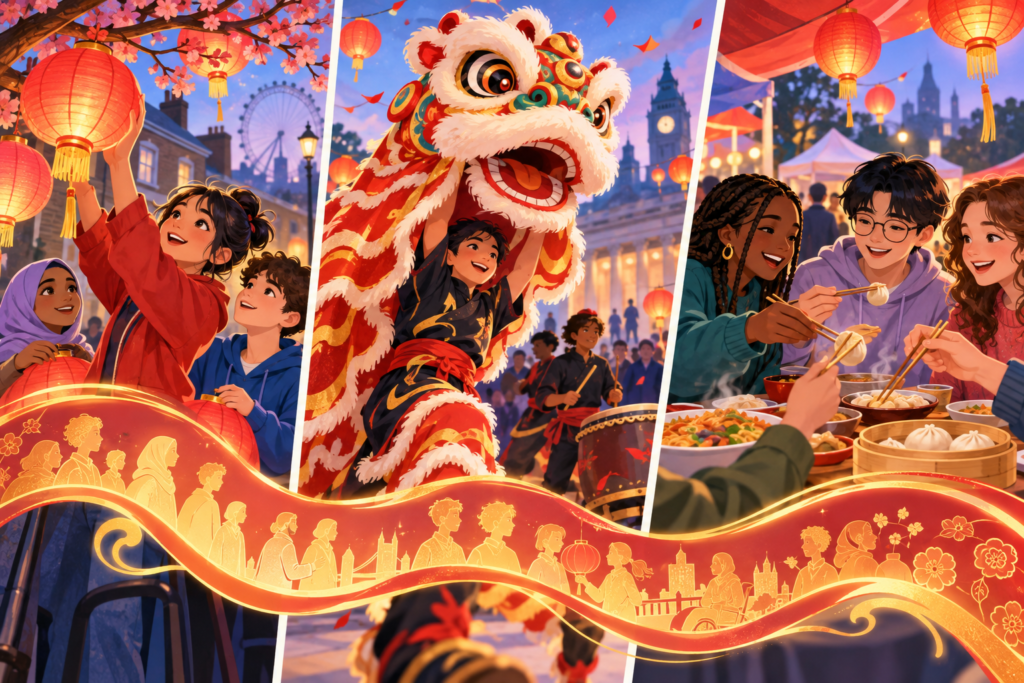
Photos of London’s Lunar New Year celebrations can fill a screen with colour. The public event is organised with community groups and reaches Chinatown and central London. Yet a parade is not what every British Chinese family does, and Lunar New Year is celebrated by several East and South-East Asian communities.
Behind the festival photograph
The London City Hall listing for the 2026 Festival of Spring describes a programme involving performances, food stalls and workshops around Chinatown and central London. It links readers to the London Chinatown Chinese Association. Those are clues to the organisations and work behind the public scene.
The listing is now a record of a past event, not an invitation to attend those dates next year. A festival can return annually while its programme, route and arrangements change. Checking the edition is part of understanding what a photograph or event page actually describes.
A public celebration needs more than performers. Someone arranges the space, prepares activities, communicates with visitors and makes the programme possible. Giving that work attention prevents a colourful crowd from appearing as though it simply materialised.
The programme also creates different ways to take part. Watching a performance is one experience; joining a workshop is another. Neither tells us what every family at the event does at home, or whether every person attending celebrates the festival themselves.
This makes the city celebration a meeting place as well as a display. Community members, visitors and curious neighbours can share an event without sharing exactly the same relationship with it. Respect begins by allowing those differences.
Names can help us be specific. If an organiser calls its programme Chinese New Year, use that name when describing the event. If discussing celebrations across several communities, Lunar New Year can provide a broader description. Neither term needs to erase the people choosing another appropriate name for their own occasion.
A school project could begin with the organiser’s account rather than a collection of the brightest images. Ask what the programme says the event is for and which activities it includes. Then distinguish that public programme from assumptions about private family traditions.
The resulting story is warmer and more accurate. It can appreciate the performance while recognising the people who prepared it, and welcome visitors without making a parade stand in for an entire community. The festival photograph remains an exciting beginning, with a human story waiting just outside its frame.
One date, many rooms
A city square, school hall and family dining room can all hold different versions of a celebration. Migration histories, local friendships and a family’s own choices shape what happens. None needs to be the “correct” copy of a single scene elsewhere.
If you want to cover a festival fairly, ask whose event you are describing. “Lunar New Year” can be a useful inclusive term; “Spring Festival” points more specifically to Chinese traditions. The people involved should be allowed to name their own celebration too.
Children helping at a workshop and volunteers preparing a performance also belong in the account. A public festival is made through participation as well as watched from the pavement.
Explore next
- The lantern that asks a question
- Is a red envelope just pocket money?
- Why does a dragon boat need a team?
Sources
- London City Hall: Lunar New Year: Festival of Spring 2026