
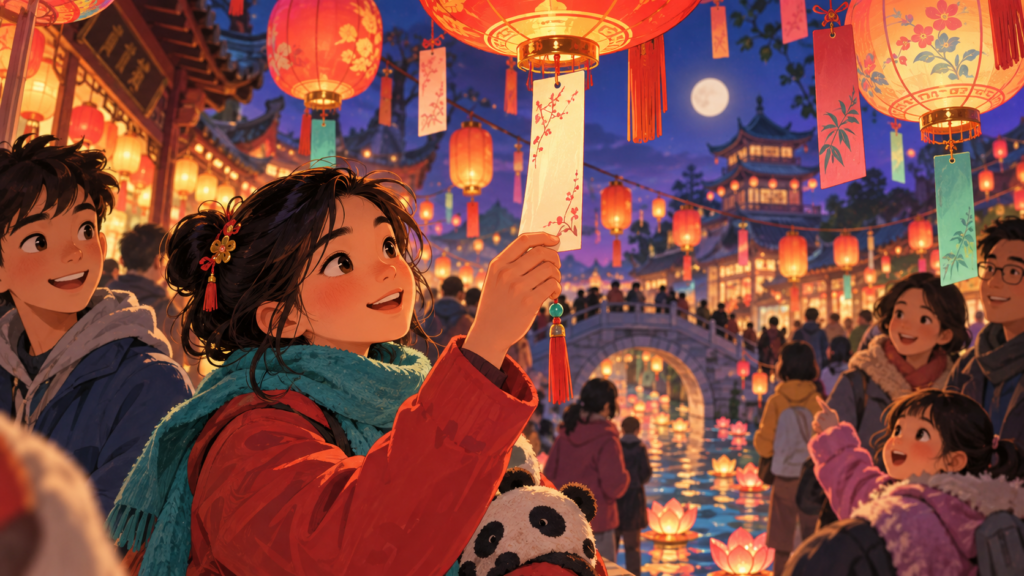
Imagine walking past a row of glowing lanterns and finding a small question tied underneath one. You could admire the colours and keep going, or stop and try to solve it. A decoration has quietly turned into a game.
Riddle-solving is one of the activities described in Shanghai’s guides to Lantern Festival. Slips attached to lanterns invite visitors to puzzle over characters, sayings and historical references. Some organised events offer a small prize for an answer. Even without one, there is the satisfaction of spotting something your friend hasn’t noticed yet.
The lantern draws you towards the question, which is a rather lovely way to start. You don’t need to arrive carrying a puzzle book or looking for a competition. The game meets you on your walk.
A puzzle you can walk through
Lantern Festival falls on the fifteenth day of the first month in the traditional Chinese calendar. Shanghai’s January 2026 guide places lantern viewing and riddles alongside eating round rice balls. The festival has several ways to bring people together; joining a word game is one of them.
A riddle can change what you do in front of a display. Instead of taking a photograph and moving on, you might stay to read it again. Someone beside you offers an answer. You explain why yours is different, then discover that both of you have overlooked a clue. The lantern has given strangers or friends something to think about together.
A puzzle involving Chinese characters may ask you to notice something about their written form or sound. That creates a different challenge from merely translating the sentence into English. Knowing what each word means doesn’t guarantee that you have spotted the connection on which the answer depends.
That feeling is familiar to anyone who has tried to explain a pun in another language. You can translate the words accurately and still lose the joke. A helpful explanation needs to show what links the clue and the answer, not simply announce that the answer is correct.
If you are learning Mandarin, an unsolved riddle can therefore be a good conversation. Ask someone to explain what they noticed first. You may learn a connection between words or characters that would have been easy to forget in a list, but is memorable because you spent a few minutes trying to find it.
Older games, changing displays
Shanghai’s historical account describes lantern riddles emerging during the Song dynasty and developing further in later centuries. It gives Suzhou as an example of a place where riddles drew on poetry, classical writing and proverbs, with small rewards for successful answers. That is a particular account of the activity’s past, rather than a complete history of every lantern celebration.
The important detail is that the questions weren’t separate from the surroundings. They were attached to something people had come to see. A public display could give reading and wordplay a place within a celebration.
Today’s lanterns needn’t repeat one old pattern. Shanghai’s learning guide describes traditional animal designs alongside modern cartoon characters. The light, shape and question can belong to different interests, so there is room for someone who loves the artwork and someone who mainly wants to crack the clue. They might be the same person.
That makes a lantern fair more than a test of how much history or language you already know. You can appreciate the colours while someone else reads; you can help compare guesses even if you haven’t found the answer yourself. Being stuck is part of a puzzle, rather than a reason to stop enjoying the evening.
Look beneath the light
A photograph often gives most of its space to the glowing shapes. The small slips can be easy to miss, especially when the display fills the picture. Once you know they may be there, a lantern scene offers something else to look for.
Next time you see one, imagine pausing underneath a single lantern. The big attraction may be its colour or shape, but the detail that keeps you there could be a few carefully chosen words. You might leave without a prize, and still carry the question home.
Explore next
Sources
- Shanghai Municipal Government: Lantern Festival
- Shanghai Municipal Government: Explore the charm of Lantern Festival