
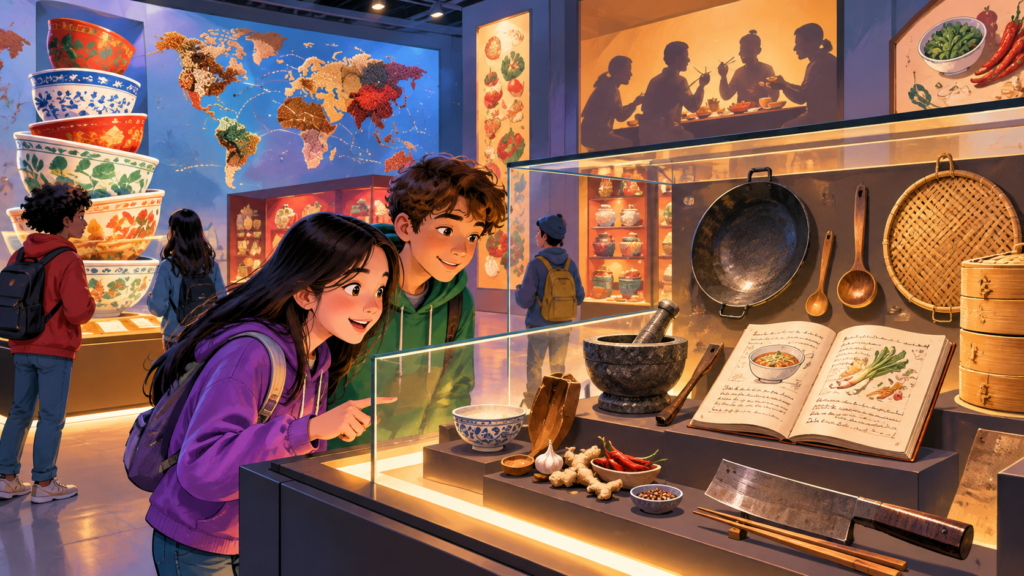
Museums often save things people are told not to touch. Food is the opposite: it is made to be eaten, then made again. UNESCO’s Chengdu profile mentions a food museum as part of the city’s gastronomy story, alongside teaching and events about local cuisine.
A pickle jar is part of the collection
The Sichuan Cuisine Museum’s own exhibition page describes a collection of more than three thousand utensils in a display area of about 1,200 square metres. Its address places the museum in Gucheng, in Chengdu’s Pidu district. This is an identified institution with objects to discuss, not a proposal for a museum that somebody might build.
Among the highlighted objects is a pickle jar dated to the Kangxi period. That description supplies a historical context without telling us everything about the individual jar. It does not identify an exact year of manufacture, the contents of every meal it contributed to or the person who used it.
The wider collection is arranged around uses including cooking, serving, drinking, dining and tea. Its materials range from bronze and pottery to wood and bamboo. A difference in material or shape can lead to a practical question: what did somebody need this object to do?
That is a different approach from simply displaying a picture of a famous dish. The tool survives after its contents are gone. A jar can become evidence of a kitchen activity, while the surrounding explanation helps connect it with the knowledge needed to carry out that activity.
The collection cannot stand for every Sichuan household. Its value begins with the particular objects and explanations it actually preserves, leaving other kitchens’ histories open to further evidence.
Save the tool, then explain the action
The Sichuan Cuisine Museum’s own exhibition page gives a concrete answer to what such a collection can hold. It groups utensils by use, including cooking, serving, dining and tea, and names materials such as bronze, pottery, porcelain, wood and bamboo.
Those categories begin with actions. A vessel used to cook and one used to serve may hold food at different stages, so their shapes and materials belong to different practical questions. Looking at the objects together can reveal a sequence that an isolated plate would hide.
The museum also describes an interactive demonstration area in which visitors are guided through making dishes. That is the museum’s description of its programme, rather than a report of a session we attended. Its combination of objects and demonstrations shows why a food collection need not rely solely on preserving finished meals.
A demonstration and a historic utensil still supply different evidence. The utensil is a surviving object; the demonstration is a present performance of a method. A useful display explains the relationship instead of suggesting that everything shown today recreates a particular historic dinner exactly.
A recipe provides another part of the record. It can preserve ingredients and instructions, but a cook’s judgement may need explanation alongside it. A phrase such as cook until ready becomes more useful when the intended change is shown or described.
Menus and photographs can record presentation and choice. They tell us what somebody offered or chose to show at a particular time, not necessarily what every household ate. A food museum can use them well by retaining dates and sources rather than allowing attractive images to stand for an entire region.
Stories from cooks can add experience, provided their accounts remain attached to the people who gave them. One person’s memory is valuable without needing to become everybody’s memory. Different versions can help explain how a preparation changed between kitchens or generations.
The museum about dinner therefore has several jobs. It can preserve tools, explain methods and make room for people to demonstrate knowledge. The food disappears when eaten, but evidence of its making can remain available for someone who wants to understand how to make it again.
A pickle jar remains after the pickles have been eaten. With its date, use and context preserved, an ordinary kitchen object can keep a part of the food story available for the next person who wants to understand it.
Explore next
Sources
- UNESCO Creative Cities Network: Chengdu profile
- Sichuan Cuisine Museum: Permanent exhibitions