
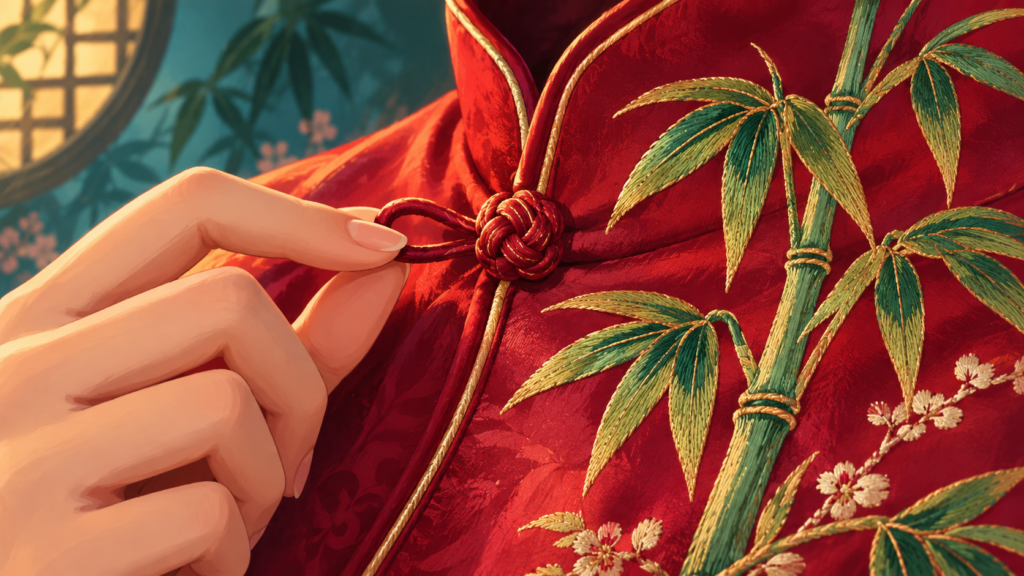
At a distance, a dress may read as one colour and one outline. Up close, it becomes a list of decisions. The V&A describes a qipao made in a Shanghai atelier in 2019, with white satin, organza, bamboo embroidery and loop-and-knot fastenings called pankou. The makers studied antique and vintage examples while using contemporary materials and choices.
Start with the small part that works
A fastening is a practical connection and a visible detail. It has to hold parts of a garment together, while also contributing to how the garment is read. Looking at it closely brings those two roles into the same view.
The V&A identifies the makers of this qipao as Guo Yujun and Xu Yulin for GUO XU. Its description names materials and construction details rather than relying only on the category qipao. That allows the visitor to follow a specific design instead of assuming every garment under the name has identical features.
Loop-and-knot fastenings involve a relationship between two parts. Their position, scale and appearance need to work with the fabric around them. A detail that seems small in the complete outline can become prominent when the wearer or viewer comes closer.
The satin and organza in the museum’s account create another relationship. Naming the fabrics helps you notice that a single white garment can contain different surfaces. A photograph may flatten them into one impression, while the description directs attention towards their construction.
The embroidered bamboo adds detail that can be followed across the surface. Instead of treating the image as a general symbol for Chinese dress, look at how the motif is placed on this particular object and how it relates to the garment’s shape.
The makers’ study of antique and vintage examples provides a source of knowledge, not a requirement to produce an exact replica. A designer can learn from earlier construction while making choices for a new garment. The date of this piece matters because it places that work in the present history of the form.
Museum records also help separate what we can see from what we might guess. Materials and attributed makers can be documented. The feelings of a wearer, the number of hours spent fitting or the meaning every viewer gives the dress need separate evidence. A detailed surface does not authorise us to invent those stories.
Next time you look at clothing in a collection, give one fastening a few moments of attention before returning to the whole outline. You may find that the smallest working part offers the clearest route into understanding the designer’s choices.
A museum photograph can show the fastening, but not necessarily the hours of fitting and adjusting it. The object record gives us a way to talk about craft without guessing what the wearers thought. A garment’s construction is evidence in its own right.
This is one designer piece, not a template for what Chinese women wear. Its details are worth noticing precisely because they belong to that particular garment. How long might it take to make a fastening look effortless? What changes when embroidery shifts shade across a sleeve? A museum can sometimes help you see a piece of clothing as someone’s careful work rather than just a style name.
Explore next
Sources
- Victoria and Albert Museum: Contemporary fashion trail