
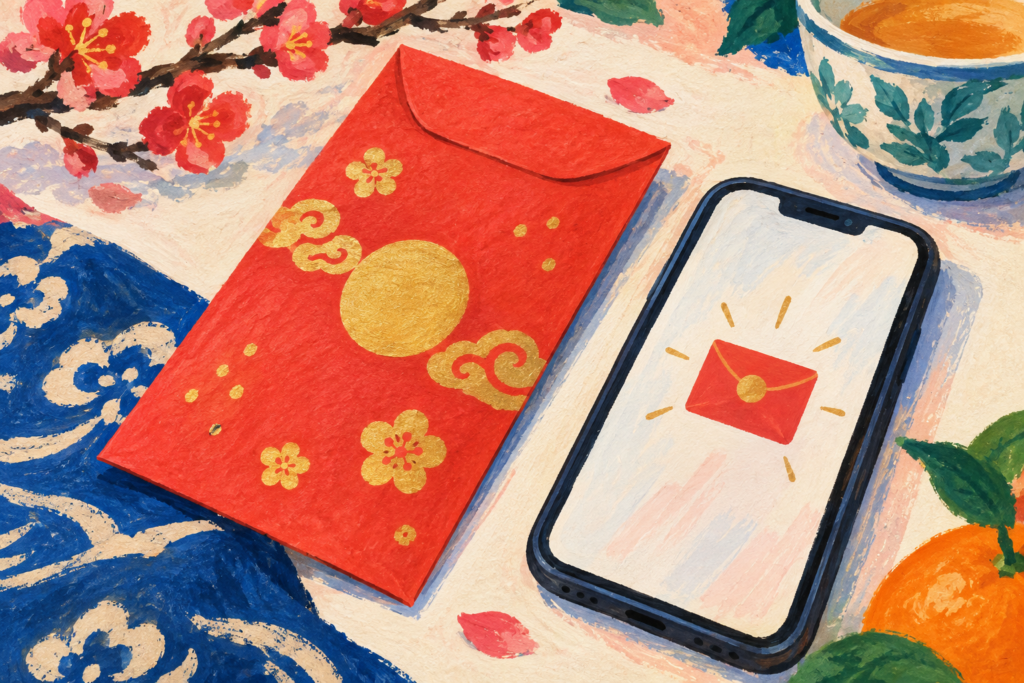
If somebody handed you a red envelope with money inside, you would probably wonder how much was there. Fair enough. Then you might notice the person who chose to give it to you, the greeting they used or a picture on the paper. The money is only one part of the present.
In many families celebrating Spring Festival, older relatives give younger ones money in a red envelope, or 红包 (hóngbāo). Shanghai’s official New Year’s Eve guide describes wishes for a child’s health, safety and happiness accompanying the gift. That gives the envelope a purpose beyond adding to somebody’s spending money.
Consider two imaginary gifts of the same amount. One arrives without a message; the other comes from a relative with a wish for your coming year. You could buy exactly the same thing with either, but you might remember receiving them differently. The relationship helps explain the gesture.
One envelope, more than one story
You may also hear 压岁钱 (yāsuìqián) used for New Year gift money. Shanghai’s account connects the phrase with a protective legend about children. That is a story told about the custom, rather than evidence that a gift can literally protect someone from harm.
A traditional explanation and a present-day reason for giving needn’t be identical. Someone could enjoy telling the legend, follow a family habit or simply want to make a child happy. We shouldn’t decide what a person believes from the colour of an envelope in their hand.
The custom also has different settings. The Hong Kong Tourism Board uses the Cantonese name lai see in its New Year guide and describes envelopes given by elders, bosses and married people. Its account already reaches beyond a simple picture of grandparents giving pocket money to grandchildren.
The names and relationships matter because they help locate the example. A Hong Kong guide is describing celebrations there; a Shanghai language lesson has a different purpose. Neither gives us a single rulebook for every household, and a family’s own practice may matter more than a visitor’s checklist.
The paper can become a screen
Shanghai’s language guide includes a teaching dialogue about red envelopes and mentions digital versions sent through WeChat. The dialogue is an example for learners, rather than an interview with a family, but it shows that the phrase can belong in a conversation about phones as well as paper.
Imagine the difference between opening an envelope handed to you and receiving a gift from someone elsewhere. The way you receive it changes what you can notice: perhaps the design and handwriting in one case, or an accompanying message in the other. You don’t have to declare one form more meaningful to see that they offer different moments.
Nor does a digital version mean that a custom has simply become brand new. A name, a gift and good wishes can carry on while the way they are delivered changes. The language lesson gives us one example of that connection, without telling us which form every person prefers.
What would stay with you?
It would be unfair to use an envelope’s contents as a score for somebody’s affection. We don’t know their circumstances from a gift, and being grateful doesn’t require making comparisons with what other people received. The useful question is what the giver meant to share with you.
If you ever receive one, you may remember the amount. You might also remember a funny message, a thoughtful wish or the person who waited while you opened it. Those details help explain why a small envelope can be remembered after its contents have been spent.
For two further questions about the Spring Festival calendar, continue here: Why call it Spring Festival in winter? and Is your zodiac sign a calendar?.
Sources
- Shanghai Municipal Government: Chinese New Year’s Eve: key dates and customs
- Shanghai Municipal Government: Chinese red envelopes
- Hong Kong Tourism Board: Guide to Chinese New Year in Hong Kong