
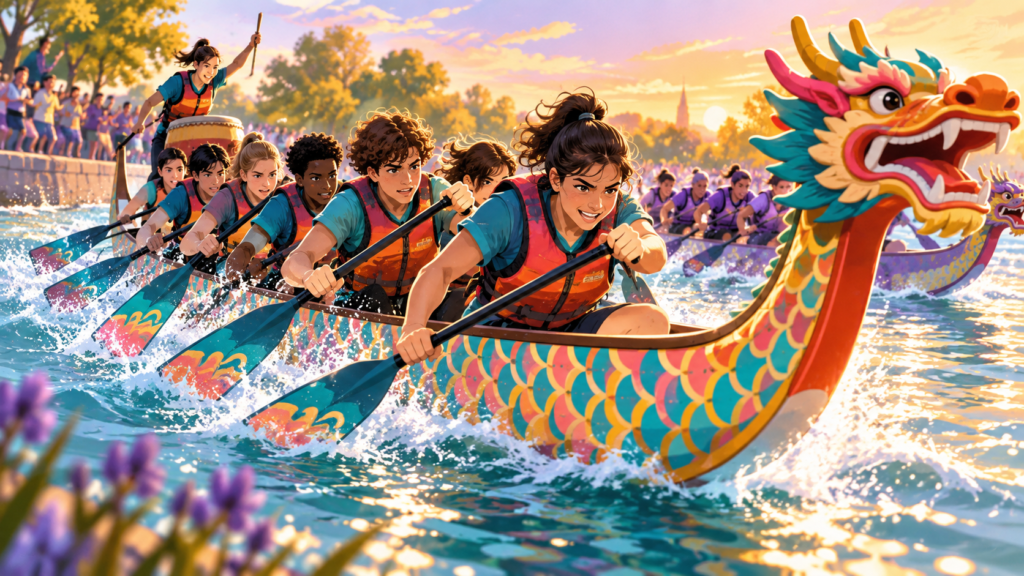
From the riverbank, a dragon-boat race looks like a problem of speed. The paddlers need to move together; one person’s brilliant effort will not rescue a boat whose rhythm has fallen apart. It is the sort of sport where you can see teamwork in the water.
Dragon Boat Festival is more than a race, however. UNESCO describes celebrations beginning on the fifth day of the fifth lunar month, especially in regions around the middle and lower Yangtze. Food, performances, customs and the person remembered can differ from place to place.
The story changes along the river
You may have heard that the festival remembers the poet Qu Yuan. That is one important account, particularly associated in UNESCO’s description with Hubei and Hunan. It is not the only local story. Treating one version as the explanation for every family and every river would erase the differences that make the festival interesting.
The food has its own variety too. Rice dumplings are often part of the occasion, but their fillings and shapes are not a single nationwide recipe. A family may remember the taste more clearly than the history of a race.
Not everybody holds a paddle
The crew includes jobs that you might miss if you watch only the paddles. The International Dragon Boat Federation describes a drummer at the front and a steering oar at the rear. The drum helps maintain the paddlers’ stroke rhythm, while the person steering guides the boat. Moving quickly and moving in the right direction are separate tasks that have to work together.
In the federation’s sport racing, a standard boat generally has eighteen to twenty paddlers, and a small boat eight to ten, as well as the drummer and steerer. Those numbers describe particular racing formats. Traditional festival boats can have different designs and much larger or smaller crews.
The distinction is useful because a photograph doesn’t necessarily tell you which format you are seeing. A modern competition and a local festival can both feature dragon boats without following exactly the same programme. The sport’s rules are not a complete guide to the celebration around it.
Imagine one paddler entering the water a moment after their neighbours. They could still be working hard, but their effort would arrive at a different point in the shared movement. That illustrates why matching a rhythm matters, without telling us what happened in any particular race.
It also changes how we think about the drum. From the bank, it can sound like part of the spectacle. For the crew, it has a practical role. The noise and the movement belong to the same piece of teamwork.
The steerer supplies a different kind of coordination. A crew cannot concentrate only on how hard everyone paddles; somebody must also guide where that effort takes the boat. None of these roles makes sense entirely on its own.
Watching for those jobs gives you more to follow than the gap between first and second place. You can notice how a group turns many separate actions into one movement, while remembering that the race is only part of what the people on the riverbank have gathered to celebrate.
A race you could describe to a friend
To explain why this festival is worth learning about, start with the paddlers and then widen the frame. Who are the people on the bank cheering for? Which story does this community tell? What is in the parcel of food somebody has brought? The answers make the event more than a colourful photograph of a boat.
The best thing about a team race may be that nobody can pretend they did it alone. The best thing about studying the festival is similar: one explanation cannot carry all its versions.
For the food and calendar questions around festivals, continue with these two stories: A rice parcel with a leaf wrapper and Why does New Year move on our calendar?.
Sources
- UNESCO: Dragon Boat festival
- International Dragon Boat Federation: History & Culture: propulsion, control and crew formats
- British Dragon Boat Racing Association: Our Sport: teams and festival racing