
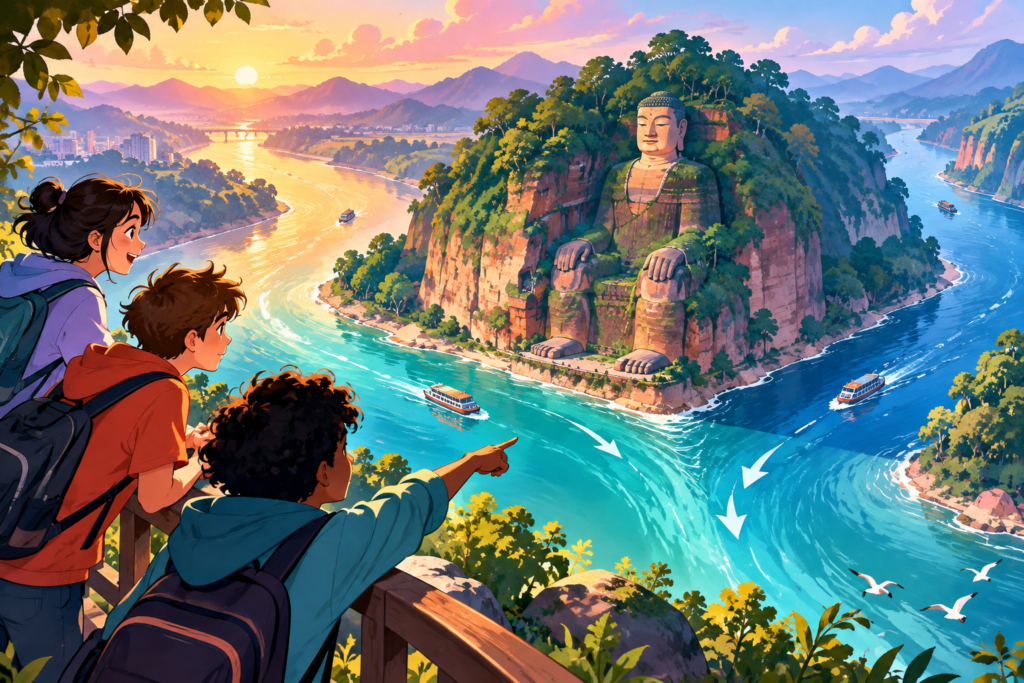
A close-up photograph of the Leshan Giant Buddha makes the sculpture seem like the whole story. Step back. It was carved into a cliff near the meeting of three rivers during the Tang period, in a landscape where water and Buddhist practice both matter.
UNESCO recognises the wider Mount Emei and Leshan area for natural and cultural significance. The sculpture is part of a landscape containing both rivers and a mountain with a long Buddhist history. Its location is central to the wider listing.
Scale is a relationship
UNESCO records the figure’s height as 71 metres and dates its carving to the eighth century. The number gives a useful measure, but it cannot convey the whole experience of scale. That depends on what else appears beside the figure and how much of the setting you can see.
A tightly cropped image may remove the cliff’s edge or the water below. The sculpture remains large, yet the viewer loses some of the relationships that explain its position. A wider image asks you to read a landscape as well as a face.
This is one reason maps and photographs work well together. A photograph shows a view from one position. A map helps locate the rivers and the neighbouring places beyond that view. Neither replaces the other, and neither requires us to invent what the person taking the picture experienced.
The wider heritage property also includes Mount Emei, where temples and vegetation contribute to its cultural and natural significance. The mountain and the sculpture are distinct parts of that property. Recognising the connection does not mean collapsing their different features into one attraction.
A religious sculpture can be studied as skilled work in stone while remaining an object with religious meaning. An engineering question about its physical setting and a question about Buddhist practice are both worthwhile. They simply need different evidence and vocabulary.
UNESCO’s account notes a contemporary inscription connected with the sculpture’s creation. That gives the historical explanation another foundation besides later admiration. A written record and the surviving carved rock can be considered together, while a modern photograph supplies a much later view.
Try arranging those three things in order: creation, historical evidence and your present view. It becomes easier to avoid describing the monument as though the camera had removed it from time. The stone’s age is part of its story, not just a number to place beneath an image.
The most useful detail to remember may therefore be its situation rather than its ranking among large monuments. At Leshan, the relationship between carved cliff and rivers makes the sculpture particular. Its scale belongs to that relationship, rather than standing on its own.
Look beyond the face
How would you decide where to place something this big? You would need to think about rock, weather, access and what the site meant to people. Those questions connect the sculpture with its setting. Its religious significance and its physical surroundings both deserve attention, without confusing one kind of explanation with the other.
The most useful travel photo might be the wide one: a cliff, moving water and a small human figure for scale. Then the Buddha becomes a work made for a particular place, not a giant object that could have been dropped anywhere.
Explore next
- How can a river be guided without a dam?
- Why are there lakes in a desert?
- The Great Wall was built in chapters
Sources
- UNESCO World Heritage Centre: Mount Emei and Leshan Giant Buddha