
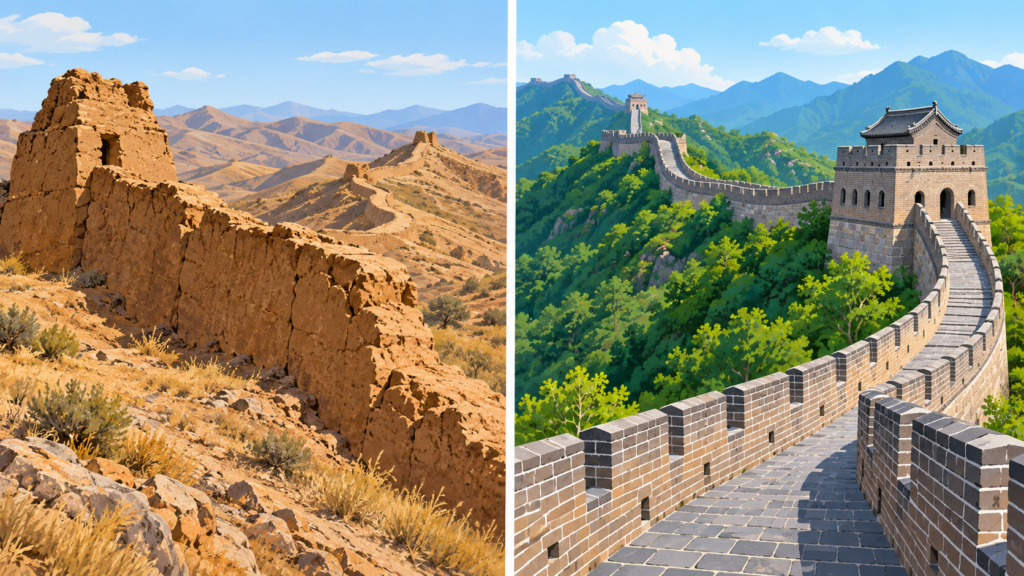
The photograph in your head probably has one long brick wall winding over green hills. Keep the hills, but make the wall change as you travel. In some places, earlier fortifications used rammed earth; in others, later builders used stone and brick. The Great Wall is a collection of structures and histories, not one afternoon’s building project.
UNESCO describes work spanning from the third century BCE to the seventeenth century CE, with earlier sections joined and later dynasties adding to and altering the system. Towers, passes and fortresses belong in the picture alongside the wall itself.
Which wall are we looking at?
That is the question to ask before making a claim about its age. A Ming-period masonry section and a much older earth-built section do not tell exactly the same story. They met different needs and used different materials available to their builders.
It is also worth asking who did the work. A monumental view can make labour disappear behind a dramatic skyline. UNESCO’s summary focuses on architecture and strategic history; a fuller article about people’s lives would need sources that follow those lives closely.
A line needs places to stop
A wall can block a route, but a defensive system also needs ways to watch and control movement. UNESCO’s description includes watchtowers, fortress passes and shelters. These give the long line different kinds of places, each doing more than adding to its length.
A tower changes the view available from a position. A pass is a place where movement through the barrier can be managed. A shelter makes sense when people have to spend time there. Taken together, the features suggest a working system rather than a giant sculpture stretching over hills.
The time span changes how we should picture construction too. Around 220 BCE, under Qin Shihuang, earlier fortifications were joined into a defensive system. That isn’t the same as saying every surviving section was built then. Later work belonged to other periods and circumstances.
UNESCO points, for example, to rammed-earth sections associated with the Western Han and masonry associated with the Ming. Earth and brick are not interchangeable clues when trying to understand one photograph. The material can help begin an investigation, although it cannot date a section reliably on its own.
Imagine labelling several wall photographs in an exhibition. A label giving only the words “Great Wall” would be true but incomplete. Adding the place, construction period and type of structure would let viewers see differences hidden by the shared name.
A map raises another issue. One neat line is easy to draw; a historical network of structures is harder. The simpler drawing can introduce the subject without representing every branch, surviving section or alteration.
None of this makes the familiar hillside view less impressive. It gives the view company. The tower, the pass and the older earth-built section belong in the story, even when one photograph has room only for a stretch of brick.
A name bigger than a single object
Calling it “the Great Wall” is useful, but the singular noun can trick us. It is a bit like calling an entire railway network “the track”: the parts connect in a history, but they are not all identical and did not appear at the same moment.
When you see a photograph, try to find its place and date. The view may still be spectacular, and now you have a better question than “How long is it?”: which chapter of a very long building story are you actually seeing?
Other historic built landscapes bring different purposes and periods into view: Can a city have a spine? and Was this imperial resort really a holiday?.
Sources
- UNESCO World Heritage Centre: The Great Wall