
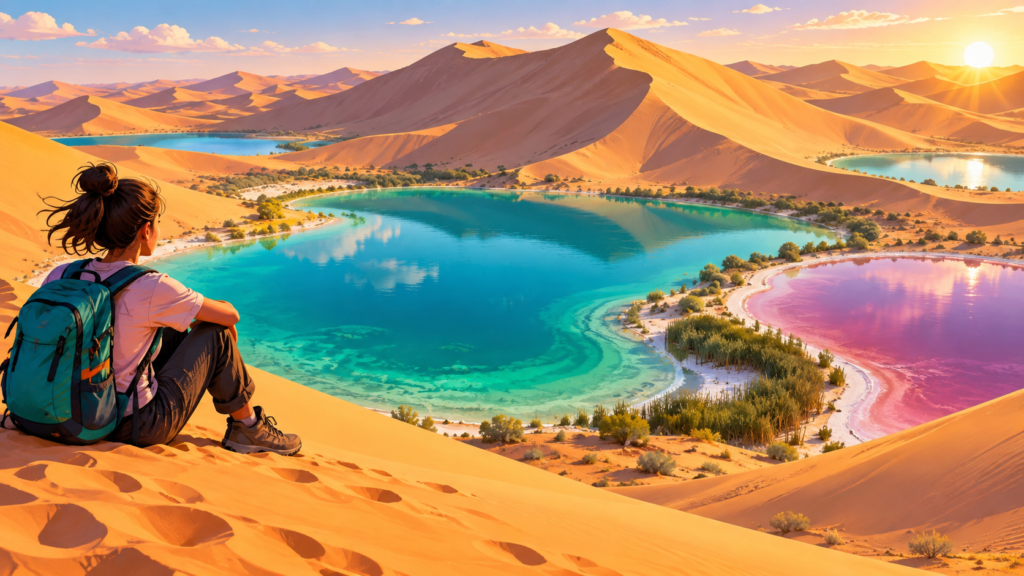
Draw a desert from memory and you might fill the page with sand and leave out the water. The Badain Jaran Desert makes that drawing look incomplete. UNESCO describes lakes lying between its huge dunes, some showing different colours because of salinity and tiny living communities.
The desert is in northwestern China, where the climate is very dry. A lake there does not turn the whole region into a green park. It shows that water can be present in particular places even when the wider landscape is arid.
Colour is not a filter
UNESCO records many inter-dunal lakes, with colours that vary. A bright lake in a photograph might look edited, but the underlying explanation can be physical and biological: water chemistry and organisms affect appearance. You would still need to know the exact lake and conditions before explaining one photograph.
The dunes are important too. One stable mega-dune has a height difference of about 460 metres from its surroundings, according to UNESCO. That is a landscape on a scale a school sandpit cannot prepare you for.
Water you cannot see from above
A lake has a visible surface, but the water supporting it does not have to arrive along an equally visible river. UNESCO identifies groundwater feeding the Badain Jaran lakes and calls for further research into those sources. What lies below the landscape is part of the explanation for what we can see on top.
That gives us a better question than whether a desert is allowed to contain a lake. How does water reach this particular depression, and what keeps its level from falling? The protected site’s description establishes the importance of groundwater without supplying a complete answer for every lake.
Think of two different drawings. One is a map from above, with dunes and patches of water. The other is a cut-through view that leaves room beneath the surface. The second drawing asks you to consider connections that a beautiful aerial photograph might never show.
The distinction matters for protecting the lakes. Managing only the edge of the visible water would miss its supply. UNESCO warns against overusing the groundwater that feeds it. A lake can depend on something outside the frame of the photograph.
Its colour is another clue rather than a complete answer. Salt levels and microscopic life help explain why neighbouring waters needn’t look identical. A bright surface doesn’t tell you that the water is fresh, drinkable or interchangeable with a river elsewhere.
And a dry climate describes the wider conditions; it isn’t a statement that every small patch of ground must be dry at every moment. Once those two scales are separated, the dunes and lakes stop looking like a mistake. They belong to the same landscape.
The first drawing wasn’t wrong because it included sand. It was incomplete because it stopped there. Add the hidden water connections and the desert becomes a place you can ask more precise questions about.
The better mental picture
Draw the desert again with space between the dunes: a lake, some plants, tracks of animals that may come out at night. The result is more complicated and much more interesting.
This does not mean you should set off towards a coloured lake without guidance. The landscape is protected and difficult to travel through. As a reader, though, you can let it correct a simple mistake: a desert is not defined by the absence of every drop of water. Sometimes the most surprising thing in the picture is right in the middle.
Another desert landscape and a story about stone pools offer two further questions about an unusual view: Can a desert sing? and How Huanglong’s water builds stone pools.
Sources
- UNESCO World Heritage Centre: Badain Jaran Desert — Towers of Sand and Lakes