
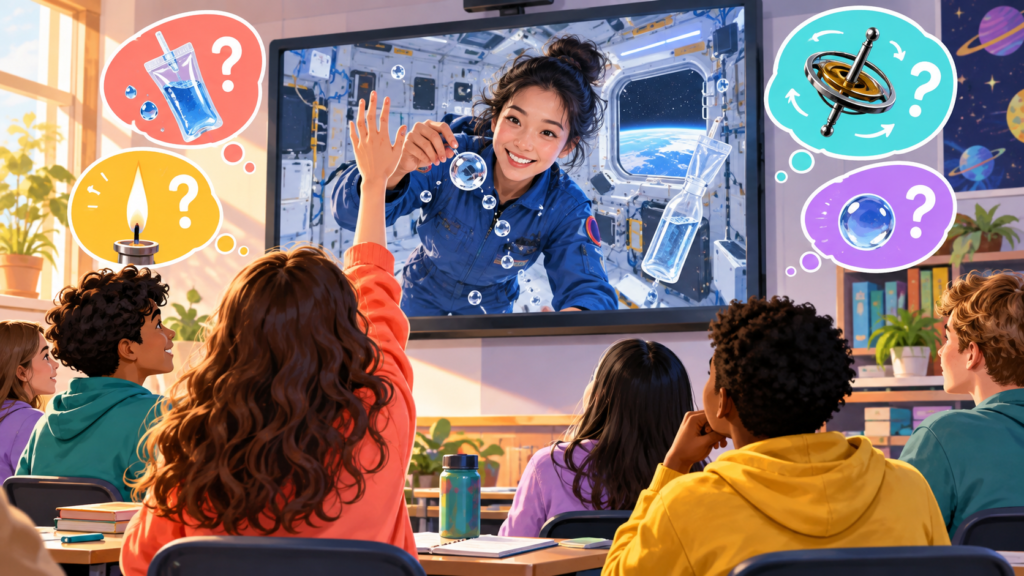
If an astronaut appeared on the classroom screen and you had one question, “What’s space like?” might be too big. How do you drink without spilling? What happens to a flame? Can a spinning object behave as expected? Smaller questions give an experiment somewhere to begin.
The China Manned Space Agency describes lessons from the space station for students on Earth. A 2022 class included water and motion demonstrations, while a later class in 2023 used experiments including a spherical flame and a spinning top. The dates matter: these were actual lessons, not a promise about tomorrow’s timetable.
Curiosity needs a test
The surprising part of space science is not that everything floats. It is that familiar things may behave in unfamiliar ways when the environment changes. A careful student asks what changed and what remained the same. That is a better habit than memorising one dramatic video clip.
The astronauts also show their working environment. A space station is both a laboratory and a place where people have to live. Each experiment has to fit alongside safety, time and equipment limits.
Give the question something to compare
A useful question could begin with an object you recognise. A drinking straw, for example, belongs to everyday life before it belongs to a space broadcast. The 2022 lesson used a very long one, turning an ordinary action into something students could examine in a changed setting.
You could start by writing down what you expect on Earth. Then describe what the astronaut actually demonstrates. Keeping those two records apart stops the surprising image from rewriting your memory of the prediction.
The 2023 lesson offered another set of comparisons. The agency records a spherical flame, a spinning top and a demonstration involving conservation of momentum. You don’t have to understand every equation before asking what the movement looks like and what question the experiment addresses.
Some questions concern the demonstration itself. Where is the camera? Can we see the whole object? Does a close-up show a detail while hiding a hand holding something nearby? Those are ordinary questions about observing, not reasons to assume the experiment is fake.
Others concern the explanation. If several conditions differ between a classroom and a spacecraft, which difference is responsible for the result? A good answer needs to identify the relevant change rather than attributing every surprising thing to space.
There is room for less spectacular curiosity too. The 2022 astronauts showed plants growing inside a special cabinet. The cabinet and the care of the plants belong to the experiment just as much as the view of the leaves.
The broadcasts connected ground classrooms with people working in orbit through video questions. That makes the distance part of the challenge of teaching. An astronaut can’t pass you the equipment, but a clear explanation can give you a comparison to carry back into your own classroom.
Your question is the beginning
An astronaut could show a failed attempt as well as a successful one. How do they decide whether the result is due to microgravity, the equipment or something nobody expected? That answer might teach more about science than the most beautiful floating water ball.
The demonstrations gave students something specific to question, rather than only a distant spacecraft to admire. You can use the same method on Earth: ask a narrow question, test it and be ready for a result less tidy than the video edit.
For more space questions, look at a water experiment and a message from the Moon: The water ball that refused to fall and A call to the far side of the Moon.
Sources
- China Manned Space Agency: The Third Live Class from the China Space Station Delivered Successfully
- China Manned Space Agency: Fourth space lesson