
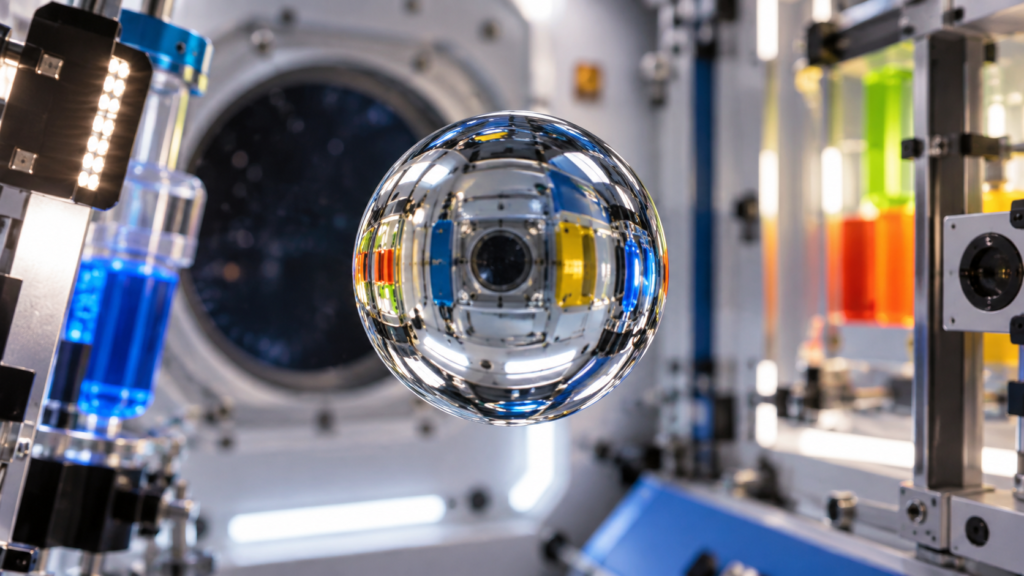
Water usually heads for the floor when you spill it. In a space lesson aboard China’s space station, astronauts demonstrated a floating water ball to students on Earth. The point was not simply that it looked like a special effect: it showed how water behaves differently when the usual sense of weight is greatly reduced.
The China Manned Space Agency’s account of a 2022 lesson describes astronauts showing experiments, their living space and even a very long drinking straw. Students could compare what they saw with experiences on Earth.
The classroom has changed location
The people teaching were doing real work in orbit. The students were on the ground. Video and questions connected the two places, but the astronauts could not hand the class a water ball to try for themselves. They had to show it clearly enough that someone watching could ask a better question.
That is what good science demonstrations do. A surprising image starts the conversation; an explanation then tries to account for it. “It looks magical” is a reaction, not the answer.
Two questions hidden in one ball
Why doesn’t the water fall to the floor, and why does it gather into a rounded shape? They sound like one question, but they need two parts of the explanation. Microgravity concerns the apparent weightlessness; surface tension concerns what the liquid’s surface does.
NASA’s student explanation describes an orbiting spacecraft, its crew and its loose objects falling together around Earth. Gravity hasn’t vanished. Because they share that motion, an object can appear to float relative to the people and cabin around it.
The floor therefore stops playing its usual role in the scene. The water doesn’t simply settle at the bottom of a cup in the way we expect while standing in a kitchen. That unfamiliar behaviour lets another property become easier to notice.
Surface tension helps hold a liquid together at its boundary. NASA describes it as an elastic-like effect, responsible for the shape of droplets. Without the usual flattening effect of apparent weight, a freely floating quantity of water can gather into a sphere.
That doesn’t mean every drop must stay a perfect ball forever. Contact with a surface changes the situation. NASA also explains adhesion, the property that lets liquids cling to surfaces. A floating ball and water touching an object aren’t identical experiments.
The Chinese space lesson made these questions visible to students who couldn’t enter the laboratory. The account describes other demonstrations too, including capillary action and plants growing in a cabinet. The water ball was one part of a working environment, not an isolated trick.
A satisfying explanation brings the two questions back together. Falling with the spacecraft changes the way weight is felt; the liquid’s own properties help determine its shape. Once you separate them, the scene becomes something to understand rather than merely an impossible-looking video.
What would you test next?
Ask what happens if the water touches a surface, or how an astronaut cleans up a stray droplet. Those questions lead from a beautiful sphere to the practical realities of living in a small spacecraft.
The lesson was a particular event in 2022, not a description of every science class in China. Its cleverness lies in bringing an unusual environment into an ordinary student’s question. A good experiment does not need to make you want to be an astronaut. It only needs to make you notice what gravity usually does without asking permission.
The space classroom and the far side of the Moon raise two further questions: What would you ask an astronaut in class? and A call to the far side of the Moon.
Sources
- China Manned Space Agency: The Third Live Class from the China Space Station Delivered Successfully
- NASA: What Is Microgravity? Grades 5–8
- NASA: What is the Fluidic Telescope? Surface tension explanation