
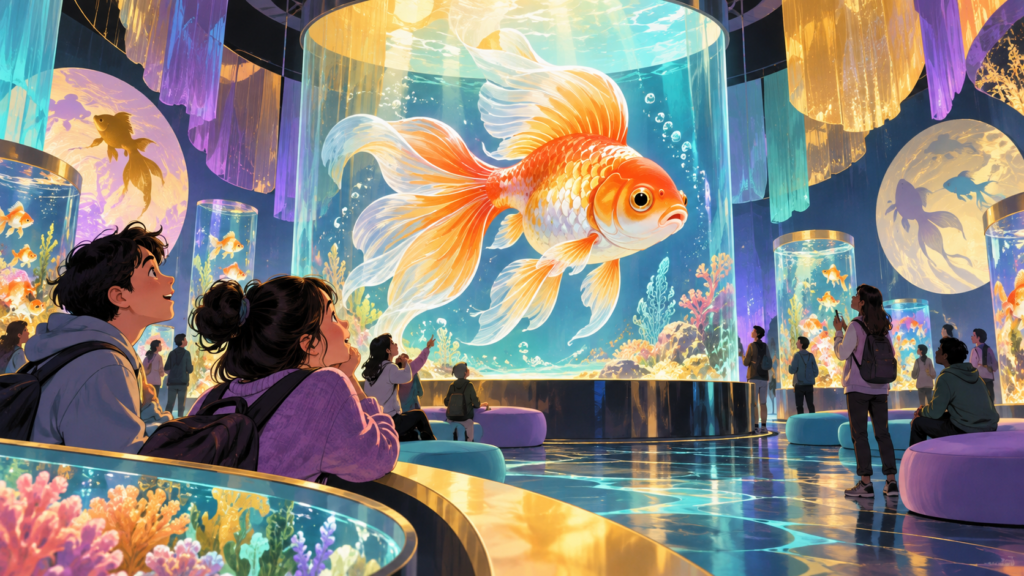
A goldfish is easy to dismiss as a small, bright shape going round a bowl. At Shanghai’s Goldfish Theatre, an immersive art exhibition opened in August 2026, the fish became the reason to build a whole visual world.
That change of scale is intriguing. Close up, a tail can look like fabric moving through water. Fins and reflections make patterns that a painter or designer might want to borrow. You do not need to own a goldfish to notice how much happens in one turn.
A designed world around a living animal
The city’s account describes digital lighting and projections arranged around ornamental fish. That brings two kinds of movement into the same scene: images designed by people and animals moving within their surroundings. They can look connected without being the same thing.
A projected pattern can follow a programme. A fish remains a living participant whose care cannot be reduced to a cue in a performance. That is the distinction to keep in view when a display deliberately blurs what is real and what is virtual.
The report says the exhibition set up a dedicated care centre with a professional team and a husbandry system. That is a stated arrangement for looking after the animals, rather than independent evidence that every welfare question has been answered. It is still an important part of the description.
A visitor could ask about both sides of the work. How did the designers choose the lighting and imagery? How do carers manage the conditions for the fish? The show contains visual choices and ongoing responsibilities, even if the photographs mostly emphasise the first.
There is room to appreciate the animal’s form without treating it only as a moving ornament. A change of direction can alter the outline of a tail; the surrounding image may change how that movement looks. The observation doesn’t require a story about what the fish feels.
If you were sketching the exhibition, two drawings might be useful. One could show the complete visual setting; another could leave the projections out and concentrate on the fish. The difference would reveal how much the presentation contributes to the scene.
The theatre idea works because it asks people to pay attention. The fuller picture includes the care behind the performance as well as the lighting in front of it.
What the spectacle leaves out
The Shanghai government describes the exhibition as inspired by China’s goldfish culture. An immersive display can be a playful way into that subject, but it is still a designed experience. Lights and projections tell us what curators want us to notice; they do not replace learning how living fish should be kept.
If a spectacular show makes visitors curious about the animals themselves, that is a useful second step. What conditions do fish need? How did particular shapes and colours become valued? Those are questions to take away, rather than answers to pretend the exhibition has already supplied.
The show belonged to a specific venue and date, so this is not a promise that you can see it on any future visit. Its idea remains: the most ordinary-looking subject can become interesting again if somebody asks you to look properly. A goldfish has been doing that all along; perhaps we have been the ones swimming past.
Compare another immersive exhibition with a museum visit centred on a familiar animal: Can an old myth walk out of a screen? and Can a cat exhibition teach you science?.
Sources
- Shanghai Municipal Government: Goldfish-themed immersive exhibition opens at Bund Finance Center