
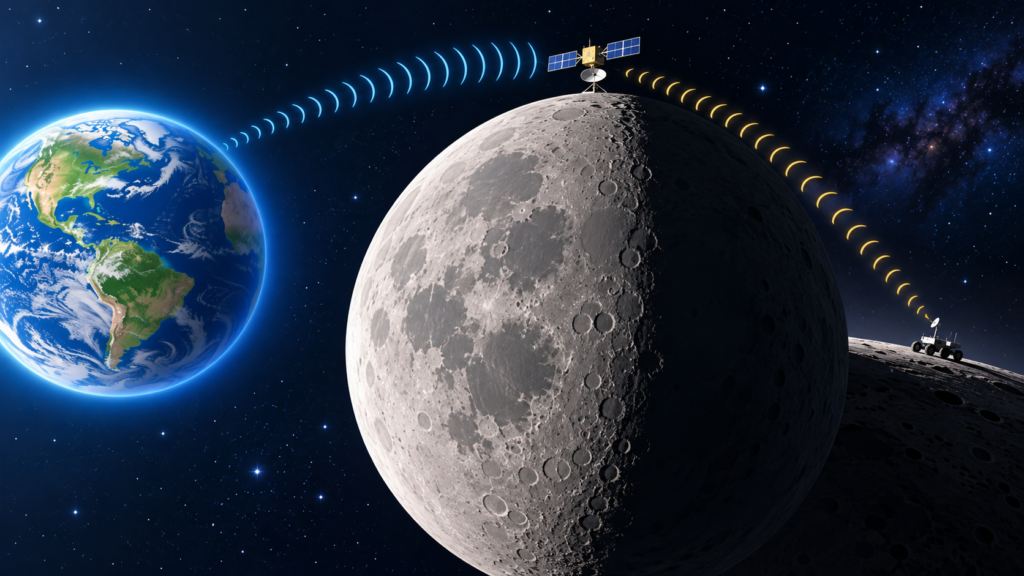
Put a robot on the side of the Moon facing away from Earth and an awkward question appears: how do you send it a message? The Moon blocks a direct radio path. China’s Chang’e-6 mission used a relay satellite, Queqiao-2, to help carry communications while the spacecraft worked on the far side.
The China National Space Administration’s mission timeline says the relay launched before Chang’e-6 and completed tests in lunar orbit. The lander then reached the South Pole–Aitken Basin in June 2024.
A message needs a route
Think of trying to speak to a friend behind a hill. You cannot shout through the rock, but somebody above the hill might be able to pass the message on. A satellite is much more complicated than that friend, yet the basic problem is similar: Earth cannot directly “see” a lander on the far side.
The spacecraft also needed to do some tasks without waiting for a human instruction for every movement. The agency described more autonomous sampling than on the earlier Chang’e-5 mission. That is not a robot making up its own science goals; it is a carefully planned machine handling steps in a difficult place.
Instructions are only part of the conversation
A lander needs to send information back as well as receive instructions. People on Earth need to know what its sensors have detected and whether an action worked. A communications route therefore supports a conversation, rather than a single command shouted towards the Moon.
The relay’s preparation came first. Queqiao-2 launched in March 2024 and completed communications tests in April, before Chang’e-6 launched in May. The sequence matters: the link was something to establish and check before relying on it during the landing.
The lander also carried sensors for making decisions close to the surface. The agency’s June landing account describes a camera selecting a suitable area and a laser scanner checking obstacles. Information gathered at the Moon helped guide the final descent.
That is a different job from choosing the mission’s scientific purpose. A machine can follow a programme for checking terrain without independently deciding what people should study. Autonomy describes particular tasks, not unlimited freedom.
The sampling followed the same principle. The agency described a programme able to carry out several movements and use sensor information to judge whether they had worked. Ground control would not have to issue a separate instruction for every tiny step.
Picture the difference between giving someone directions to a desk and telling them the angle of every footstep. The first leaves room to respond to a chair in the way; the second would be painfully awkward. A spacecraft programme is more exacting, but the comparison explains why local feedback matters.
The returned samples show the consequence of getting these less visible arrangements right. Communication, sensing and programmed actions sit behind the dramatic images. The landing is a moment in the story; the route for a message is part of what made that moment possible.
Why the far side?
The far side is not permanently dark. It gets sunlight as the Moon turns around Earth; it is “far” because it faces away from us. That one word has confused plenty of people until they picture the geometry.
Chang’e-6 returned samples to Earth. The mission is a good reminder that exploration is often about solving quiet problems before the dramatic landing: put the relay in place, test the route, then ask the robot to pick up rock.
For related questions about space missions and positioning, continue here: Is two kilograms of Moon rock a lot? and How does your phone find you from space?.
Sources
- China National Space Administration: Timeline of Chang’e-6 mission
- China National Space Administration: Chang’e-6 lands on moon’s far side to collect samples