
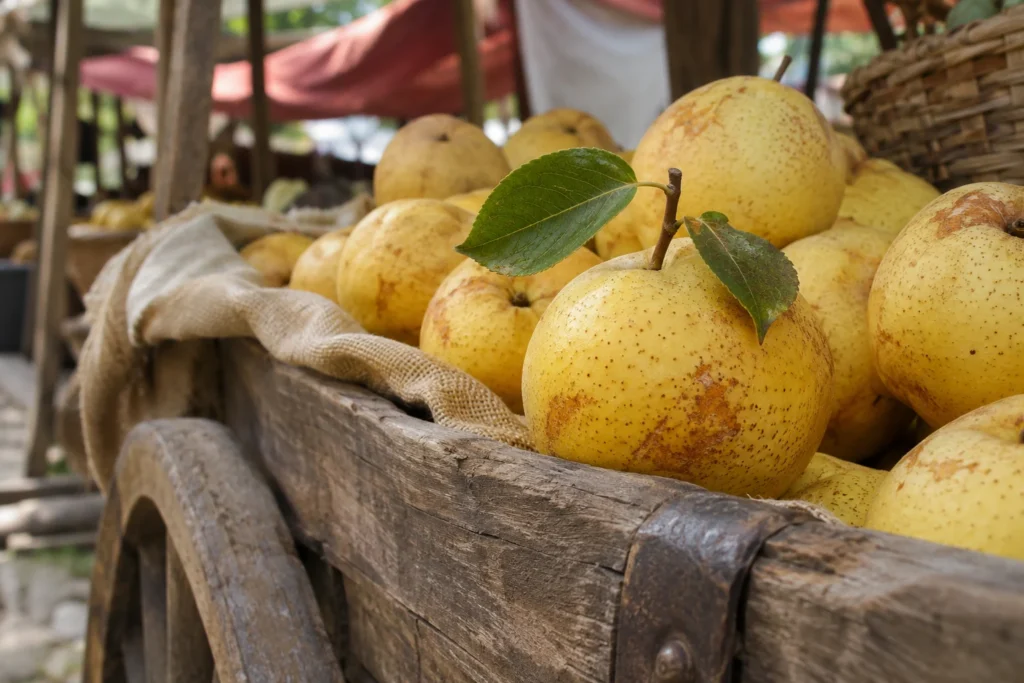
The pears were sweet, fragrant and ready to sell. Their owner expected a profitable day at the market.
Then a ragged religious wanderer asked him for one.
The seller refused. The stranger asked again. Soon everyone nearby was listening to the argument. There were hundreds of pears in the cart; surely one small pear would not ruin him?
The seller still refused.
At last a craftworker bought a pear and gave it to the wanderer, who ate it with obvious enjoyment.
“Now I can share some pears of my own,” he announced.
A very fast-growing tree
He kept a seed, dug a little hole and planted it. Someone brought water.
A shoot appeared. It grew into a tree. Branches spread, flowers opened and, before the watching crowd had recovered from that surprise, ripe pears hung among the leaves.
The wanderer climbed up and passed the fruit down. Everyone could have some.
Even the seller forgot his business and squeezed closer to watch.
When the pears were gone, the wanderer chopped down the tree, lifted it onto his shoulder and walked away.
Only then did the seller turn back to his cart.
It was empty.
The pears handed out so generously had been his own. Worse, a wooden part had been cut from the cart. He hurried after the stranger and found the missing piece lying near the city wall.
So that had been the marvellous tree.
The wanderer had disappeared. The crowd had not, and it was enjoying this final part of the performance enormously.
The seller had saved one pear from a hungry stranger. It had proved an expensive saving.
About this retelling: Retells “The Miserly Farmer”. The religious wanderer is not assigned a more precise identity than the inspected source supports. The tree’s trick and the missing cart part are retained. Based on chapter XXXIII of The Chinese Fairy Book (1921), edited by Richard Wilhelm and translated by Frederick H. Martens. This is one recorded version, retold here in new wording.
Another story?
Try The garden guests who feared the wind, or meet the characters in The dragon sleeping among the books.
Sources
- Project Gutenberg · public-domain 1921 edition: XXXIII THE MISERLY FARMER — The Chinese Fairy Book (1921), Richard Wilhelm / Frederick H. Martens