
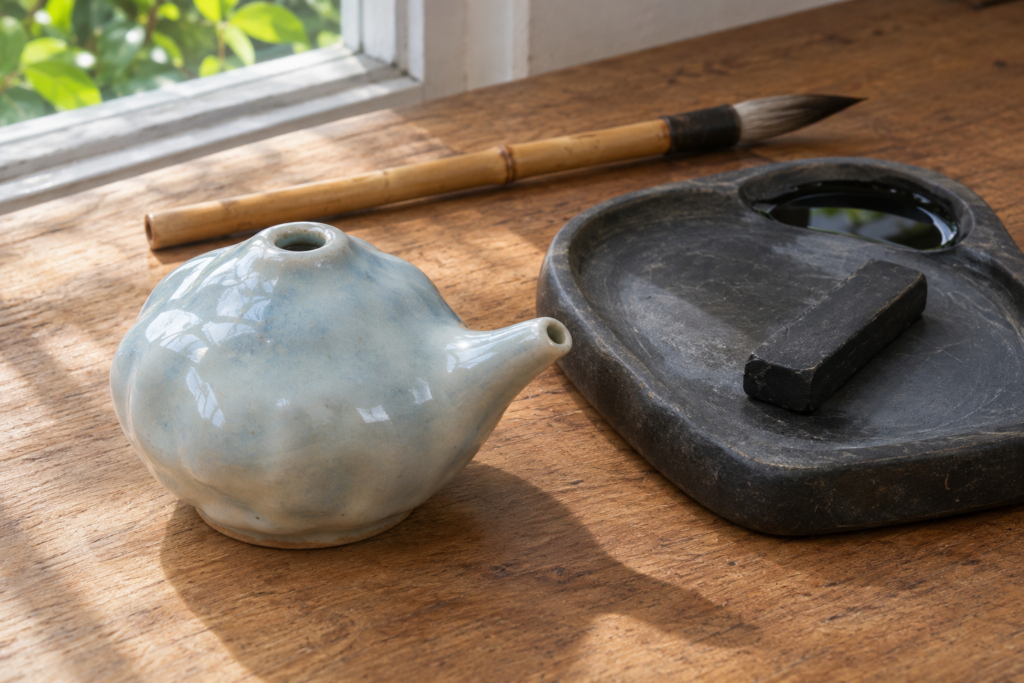
A small Song dynasty water dropper in Princeton’s collection is just seven centimetres wide. There’s a spout, a loop handle and an opening on one side. A few drops from a vessel like this were useful on a writing desk in China. The ink could start out as a solid stick, and water was what let a brush pick it up.
Mixing a brushful of ink
Start with an inkstone. It has a surface that the ink stick can rub against. Add a little water and grind the stick on the wet surface. Some of the ink comes off and mixes into the water. The more ink you grind into that amount of water, the darker the liquid can become. Add more water and you can get a paler tone. If you want to see what the grinding surface looks like, we’ve also looked at an inkstone with two dates.
A big splash can give you more liquid than you need. A small dropper lets you add water bit by bit. Think about mixing paint for a tiny drawing. Once there’s plenty on the palette, you have to do more mixing to change the colour. Starting with just a few drops gives you room to adjust as you go.
The hole that lets air in
Some droppers have two openings with different jobs. Water comes out of the spout. Air can enter through the other hole as the water leaves. In the type described by curator Eva Ströber, a finger over that opening helps stop the flow. Lift the finger and the dropper can let water out again. The same idea is at work when you hold a finger over the top of a straw full of water and lift the straw out of a glass.
Look at the shape of the Princeton piece. The body is made of two rounded sides joined together. Small raised dots and floral patterns decorate the pale blue glazed surface. The filling hole on one side makes sense once you know there needed to be a way to get water into that little chamber. Other droppers hide their openings in the shapes of animals.
A tiny creature with a job
The Met has an eighteenth-century example from Jingdezhen shaped like a mythical animal. It’s made of porcelain and covered in a greenish-brown glaze that looks like the aged surface of bronze. It’s only 8.3 centimetres long, so roughly the length of a bank card. You can imagine it fitting next to a brush on a crowded desk.
There’s a neat question to ask when you see a small ceramic animal in a museum. Where are the openings? On a water dropper, those little holes may tell you more about how it was used than the shape does at first glance.
Sources
- Princeton University Art Museum: Small water dropper, Song dynasty
- Eva Ströber: Ceramic water droppers in the collection of the Princessehof Ceramics Museum
- The Metropolitan Museum of Art: Water dropper in the form of a mythical creature