
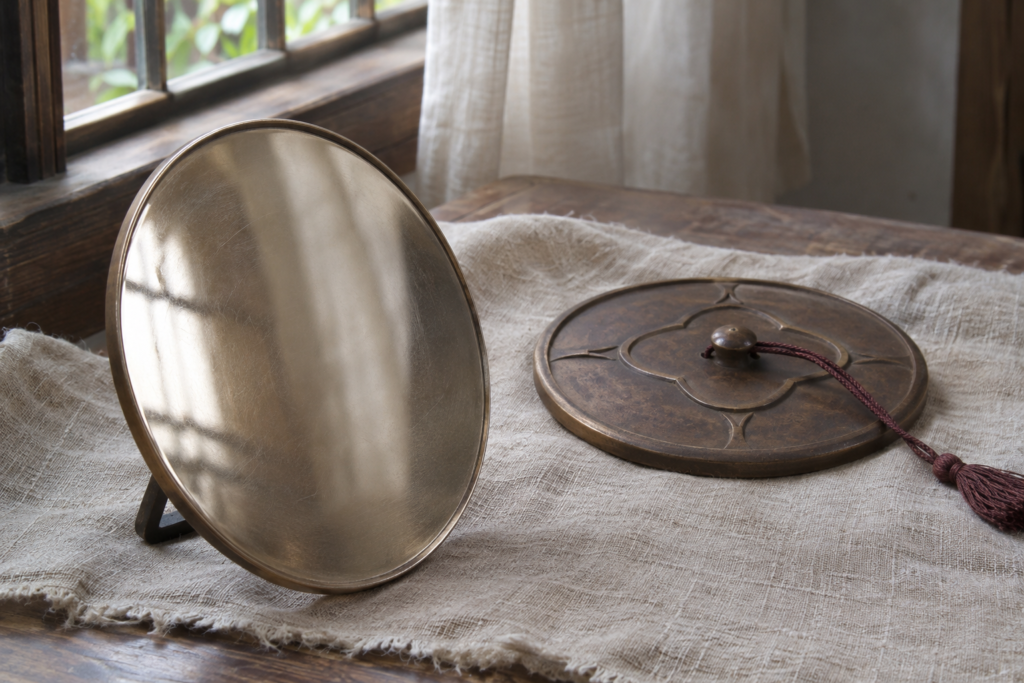
The patterned side of an old Chinese bronze mirror is usually its back. Turn it over and the working face is a smooth metal surface, polished enough to reflect you. There doesn’t have to be any glass: the bronze itself does the job.
That makes a museum mirror a small two-sided puzzle. The decoration grabs your attention, but the quieter side explains why somebody wanted to own it in the first place.
The button is part of the handle
A mirror from Luoyang, in China’s Henan province, helps show the arrangement. The University of Hong Kong’s museum resource dates it to the Han dynasty, 206 BCE to 220 CE. It’s 15.8 centimetres across, roughly the width of a small side plate, with a decorated back and a knob in the middle.
Look closely at that knob and there’s a hole through it. A cord could pass through the opening so someone could hold the mirror without handling its reflective face. Think about the fingerprints on a phone screen: the part you need to see clearly is also a part you want to avoid touching.
A green mirror wasn’t always green
The University of Michigan Museum of Art explains that traditional mirrors combined a polished face with raised decoration cast into the back. If you’ve read about casting patterns in bronze, here’s another use for the idea: a functional metal disk could also carry a carefully made design.
Surviving mirrors can look silvery, green or black. The museum links those differences to the metal mixture and to conditions during burial. Bronze contains copper and tin, and the surface you see centuries later isn’t automatically the surface its first owner saw.
That matters when an old mirror looks too dark to reflect much. Its present appearance doesn’t mean it was designed that way. This is a reason to read the museum’s account of the object, rather than judge its original usefulness from colour alone.
Something worth putting away carefully
Research published by the University of Oxford describes silk and wooden cases used to protect mirrors. Their reflecting surfaces could become cloudy and need polishing during use. Keeping a mirror meant looking after its surface as well as its decorated back.
There’s a further catch when you try to date one. The Australian Museum has a mirror with a design typical of the Han dynasty, yet identifies that example as probably a replica from the thirteenth or fourteenth century. An old-looking pattern doesn’t establish when the object carrying it was made.
Chinese mirrors also served as gifts and accompanied people into tombs, as the Australian Museum explains. Their meanings went beyond checking an appearance, and the designs varied across periods. Much as a carved seal combines a practical mark with visual design, a mirror could be useful and carefully decorated at the same time.
Next time you spot one in a collection, try finding three things: the patterned back, the central button and the face that once caught the light. You might be looking at the most decorative side of an object whose everyday work happened on the other.
Sources
- University of Hong Kong, University Museum and Art Gallery: Mirror from Luoyang, accession HKU.B.1954.0151
- University of Michigan Museum of Art: Mirror with serpentine interlaces and angular meanders, accession 1958/2.76
- University of Oxford, TORCH; Wenrui Li: Bronze Mirrors: Reflections of China, 9 October 2020
- Australian Museum: Chinese Bronze Mirrors, updated 14 June 2023