
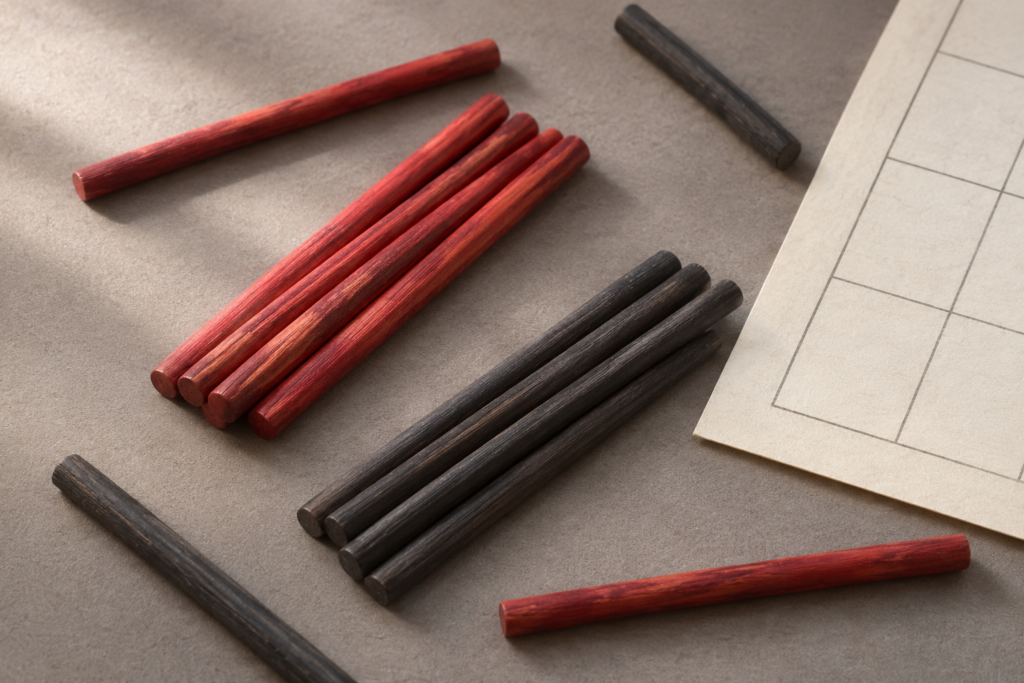
A red stick could stand for a positive number and a black one for a negative number in a system described by the Chinese mathematician Liu Hui in AD 263. He also recorded a second way to tell them apart. One set could lie straight and the other at a slant. If both sets of sticks were the same colour, you could still see which number was which.
These were counting rods, little sticks that could be arranged and moved around on a flat surface. Think of a numbers game where the pieces change value depending on which space you put them in. The clever part is what happens when you leave one space empty.
Give each digit a space
Draw three boxes side by side and give them the jobs our digits have today. From left to right, they stand for hundreds, tens and ones. A two in the first box is worth 200, while a two in the last box is worth 2. Put both on the board with the middle box empty and you get 202. The gap has done a job that the printed zero does for us.
Historical rod numerals also used two sets of shapes. The ones and hundreds places used one set. The tens place used the other. At low values the same digit could be made with parallel rods running one way or turned through a right angle. Alternating those forms helped show where one digit stopped and the next began. That matters when a number is a little pile of sticks and an empty space might be easy to miss.
The boxes are a way to try out the idea on paper. A grid in a modern illustration need not reproduce exactly how a particular mathematician laid out a calculation.
What does a black stick do?
Try a smaller example with two colours of paper, so you can swap out the sticks. Let one red piece mean a gain of one point and one black piece mean a loss of one. Start with three red and five black. Pair each red with a black and take the pair away, because +1 and −1 add to zero. Three pairs disappear and two black pieces remain. Your total is −2. This is a modern way to make the two signs visible, using the idea behind Liu Hui’s colour convention.
The same distinction mattered when scholars solved problems with several unknown amounts. The eighth chapter of The Nine Chapters on Mathematical Procedures, the book Liu Hui commented on, includes rules for handling positive and negative numbers while working through such problems. Centuries later, scholars including Qin Jiushao and Yang Hui wrote out rod-style diagrams. The diagrams show how a sign could be marked in different ways, including a slanting stroke in Yang Hui’s work.
Try one last move with the three boxes. Start with a two in the tens box, then shift it into the hundreds box, turning its rods to suit the new place. Twenty becomes two hundred without adding a single stick. For another way that grouping changes how a number looks or sounds, try why a million is a hundred ten-thousands.
Sources
- Yiwen Zhu: The interplay between textual procedures and material operations from the viewpoint of Chinese mathematical texts
- University of St Andrews, MacTutor: Chinese numerals