
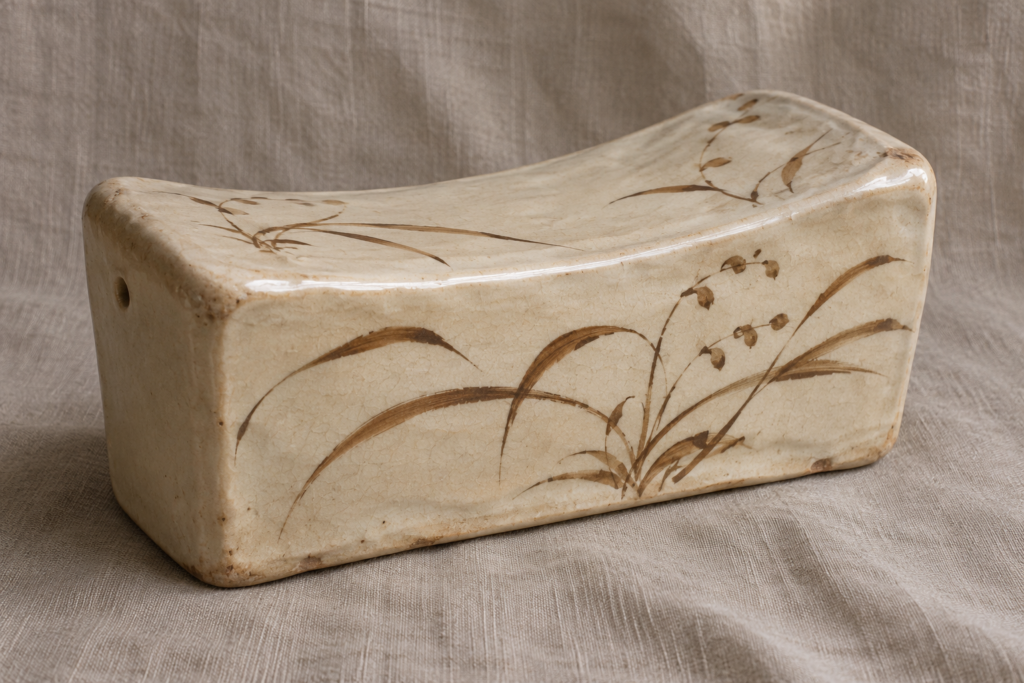
A ceramic pillow in the Metropolitan Museum of Art is 15.9 centimetres high, roughly the height of a short ruler. Made by the Zhang family workshop in China in the thirteenth or fourteenth century, it has a glazed stoneware surface decorated with landscapes and a tiger. It looks like something you would take care setting down. A pillow like this could hold up your head.
A curve where your head goes
One way to figure out how a hard pillow might work is to look at the top. Princeton University Art Museum has a twelfth-century one shaped like a tiger lying down. Its back dips into a broad, rounded hollow that the museum identifies as a headrest. The tiger’s tail curls against one side, leaving the curved back clear. You can read the animal in the outline and see where a head would go.
Compare that with a cushion. A cushion takes its shape when you put weight on it. A potter working with clay has to make the shape before the piece is fired. On the tiger pillow the curve is built in, like the dip you make by pressing your thumb into a piece of modelling clay. The finished tiger is 38.7 centimetres long. Its curved back is big enough to do the job of a pillow.
Painting on a pillow
The Zhang workshop pillow was made in the Cizhou tradition. The Met places the kilns associated with that tradition near Handan, in Hebei in northern China. Potters there also made bowls, cups and bottles. On this pillow, the workshop covered the stoneware with white slip, a liquid mixture of clay and water. They painted over the pale layer and covered the design with clear glaze. Think of the light slip as a ground for the picture. The finished surface could carry a landscape across an object you might have used at home.
A second pillow at the Met takes a different approach. Made in the twelfth or thirteenth century, it is shaped like a reclining woman. It measures just under 23 centimetres long, a little over half the length of the Zhang workshop pillow. It is porcelain, with carved and incised decoration under its glaze. Even two objects made for much the same job can feel quite different when you look at the material and how the maker worked it. For more on those finishes, see how celadon gets its colour and why porcelain is called china.
Would it feel comfortable?
The Met mentions a possible use for some ceramic pillows as neck rests that helped keep elaborate hairstyles in place overnight. That is one explanation. The shape of each object tells us something we can see for ourselves. Look again at the Princeton tiger and try to spot the point where the sculptor had to think about the person using it. It is right in the middle of the animal’s back.
Sources
- The Metropolitan Museum of Art: Zhang family workshop pillow with landscapes and a tiger
- Princeton University Art Museum: Pillow in the form of a Tiger
- The Metropolitan Museum of Art: Pillow in Shape of Reclining Woman