
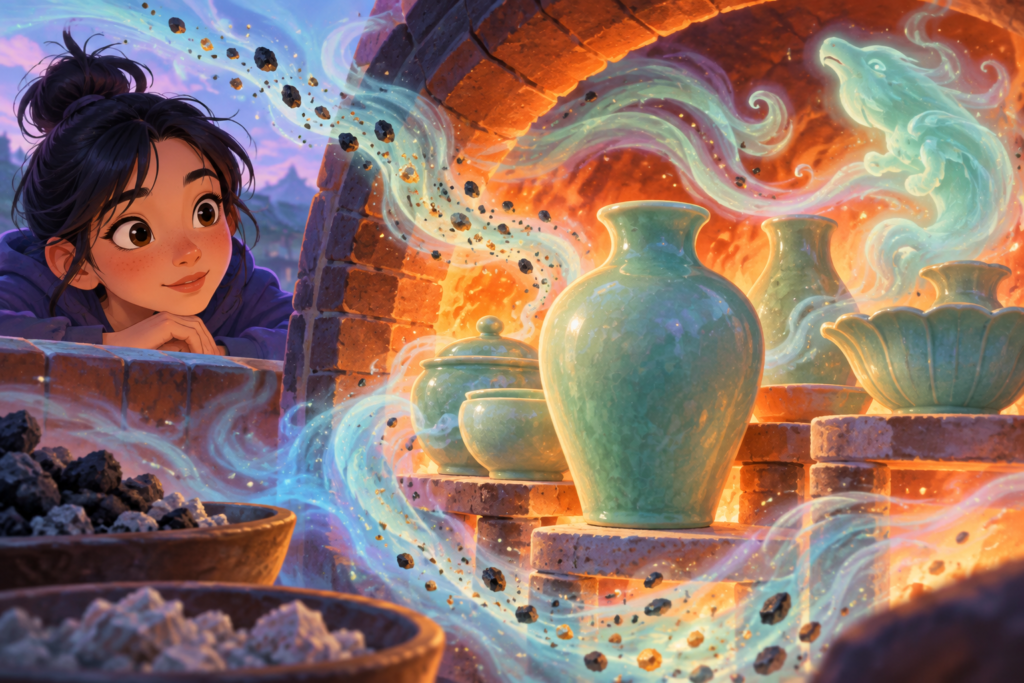
You cannot see the air inside a fired kiln, but you can see what it helped do to a pot. Longquan celadon, associated with Zhejiang, is known for greenish glazes. Iron in the glaze and carefully controlled firing conditions play important parts in the colour that emerges.
UNESCO recognises the traditional firing technology as a living craft. A maker prepares materials, applies glaze, loads the kiln and judges the result. The same recipe does not guarantee the same surface every time.
The kiln changes the question
A glaze is a prepared material transformed by firing, not a coat of ordinary paint added to a finished bowl. Its composition and the firing environment work together. Describing the unfired ingredients alone would leave out a decisive part of the process.
The Metropolitan Museum’s explanation of celadon connects iron in the glaze with firing in reduced oxygen. The amount of oxygen is therefore one of the conditions behind the colour. The general mechanism helps explain why looking only at a green surface cannot tell you everything about its production.
For Longquan, UNESCO describes heating and cooling through carefully controlled stages. Experienced artists use temperature readings and observation of the flame. Their judgement relates to a changing process, rather than one moment when somebody decides the bowl looks ready.
Cooling belongs to that process too. A finished glaze is encountered after the thermal stages have taken place. A photograph of the cooled bowl cannot show the sequence directly, although it can preserve some of the results.
UNESCO’s account distinguishes named styles with different surface effects, including crackle and variations of colour. That is another reason to avoid a single imagined paint-chart green. The tradition includes differences that are part of its vocabulary, not automatically mistakes.
Recipes are also passed between teachers and learners or within families. A written list of ingredients can preserve information, but using it successfully involves understanding preparation and firing. Technical knowledge includes the judgement needed to recognise changing conditions.
For a museum comparison, choose two pieces whose labels identify their place, period and materials. Note the colour, surface and shape separately. Then check what the labels actually explain about technique. Similar colour does not necessarily establish an identical workshop or history.
The interesting part is how a visible result brings several less visible decisions together. Material preparation, glaze application and firing each contribute without being separately displayed on the finished object. Celadon’s colour is a good starting point for asking about those decisions, even when the kiln itself is nowhere in the picture.
The colour you cannot paint on
Imagine painting a bowl green and then discovering the final shade depends on a hot room you cannot safely open to check halfway through. That is why experience matters: the finished colour carries invisible decisions.
Celadon is not one exact green, and it is not every green pot. If you see two pieces side by side, look for the differences before asking which one is “correct”. A colour can be a record of how something was made.
Explore next
- How can a flame change a bowl?
- Paper made slowly on purpose
- Why are museum gifts turning into plush toys?
Sources
- UNESCO Intangible Cultural Heritage: Traditional firing technology of Longquan celadon
- Metropolitan Museum of Art: Kawase Shinobu's Celadon Jar: iron and firing atmosphere