
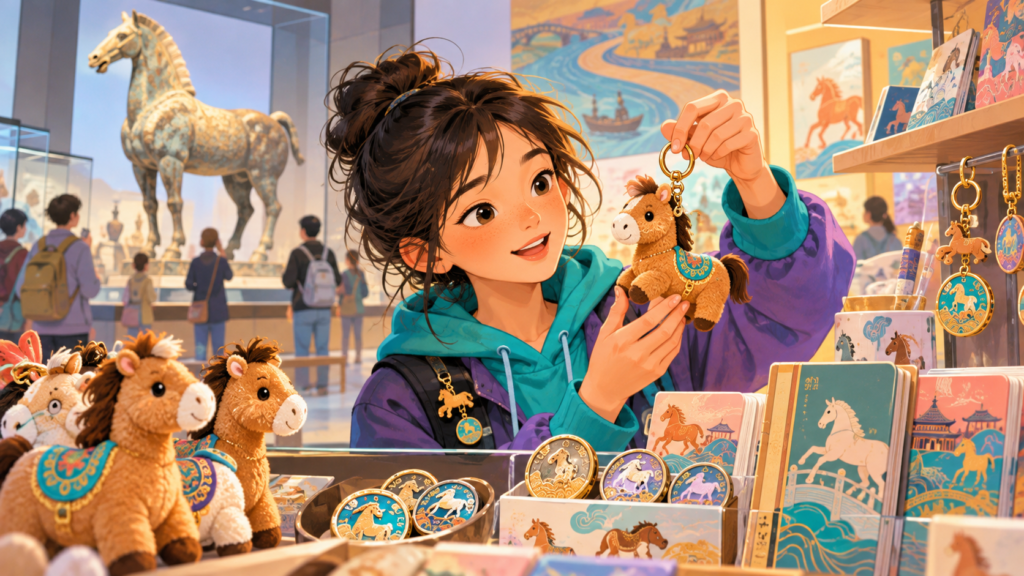
Imagine a museum object looking back at you from a keychain. Beijing museums offered Year-of-the-Horse souvenirs in 2026, including plush toys, badges and magnets. One city guide described how the Grand Canal Museum drew on its collection, while other institutions made their own horse-inspired designs.
A small object cannot carry an entire history lesson. It can, however, make somebody ask what inspired it. Why that horse? What is the original object made from? What did it mean before it became something soft enough to clip to a bag?
What changes when a horse becomes soft?
The Natural History Museum’s horse toys took inspiration from specimens in its collection. A specimen and a toy have very different purposes. One belongs to study and display; the other is designed to be handled and recognised quickly.
A plush version has to translate rather than reproduce everything. It may keep an outline or a memorable feature while changing proportions and materials. The result can be appealing precisely because it isn’t pretending to be an exact scientific model.
Other souvenirs begin with artwork instead. The city guide describes the Xu Beihong Memorial Museum placing horse-painting imagery on products such as notebooks and stickers. Here the starting point is a painted representation, not the animal itself.
That gives us two different routes back into a collection. For one object, you could ask which specimen inspired the shape. For another, you could look for the painting and compare the selected image with the complete work. The same horse theme doesn’t make the histories identical.
Size brings another choice. A detail that works in a large painting may become difficult to read on a tiny magnet. A designer has to decide what survives the change and what would make the smaller object confusing.
You could try that without a shop: choose a picture and draw a very small version. Notice which features you keep first. The exercise shows why a souvenir’s simplification can be purposeful rather than merely careless.
The useful label is the one that helps connect the new object to its starting point. Cuteness gets somebody to look; context gives them somewhere to go next. A soft horse can be a beginning, provided the route back to the collection remains visible.
The gift-shop test
A good souvenir makes you want to go backwards, from toy to collection. A weaker one is just a cute shape with a museum label attached. You can test the difference without buying anything: find the original object or story, then see what the designer kept and what they changed.
The Beijing guide described particular products for a particular holiday. It does not prove that every museum now works this way, or that a toy is the best way to learn. You might remember an unexpected detail from a display more clearly than anything in the shop.
Still, if a plush horse sends someone back into a gallery to find its ancestor, it has done more than decorate a shelf. The interesting part is not whether you own the souvenir. It is whether you can tell the story hiding inside its stitches.
Two more souvenir stories ask how a familiar object or character takes on a new form: From Han-dynasty cat to soft toy and Why is an Olympic panda wearing a horse costume?.
Sources
- Beijing Municipal Government: Looking for a Year of Horse Souvenir? Head to a Museum This Weekend