
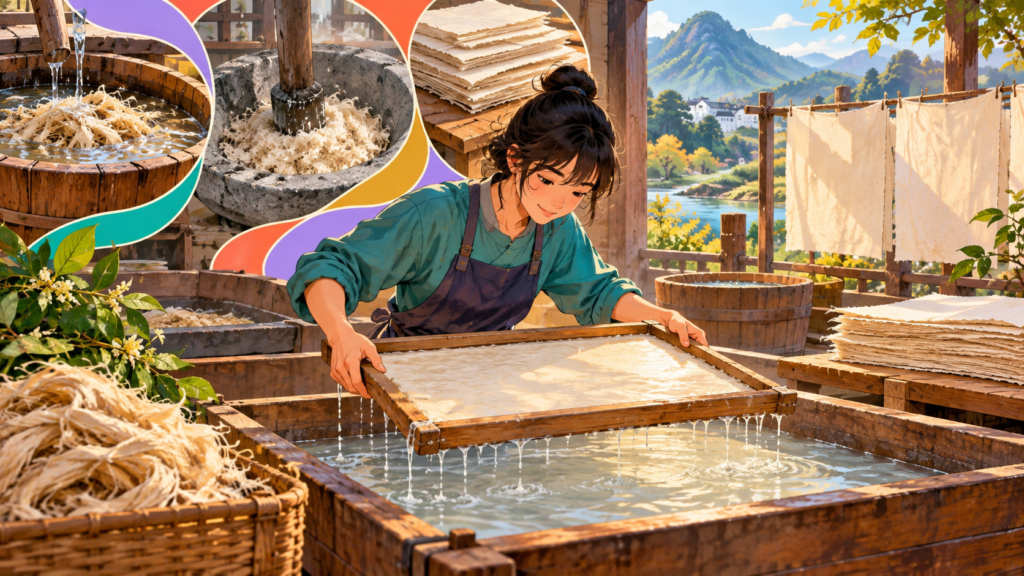
Most of us do not think about paper until it runs out. In Jing County, Anhui province, a traditional kind called Xuan paper has a much longer story before anybody draws a line on it. UNESCO describes a handmade process with many stages, from soaking and washing to drying and cutting, that can last more than two years.
The paper is made from particular plant materials, including bark and rice straw. The local environment matters too. That means it is not simply a recipe you can print on a packet and reproduce anywhere without change.
The page is already a piece of work
Xuan paper is valued for how it takes ink and for its strength. Calligraphers and painters can use those properties, but the maker’s work happened first. When we praise only the final painting, it is easy to miss the craft that helped it exist.
UNESCO’s page describes a sequence of more than a hundred steps in the traditional process. It also explains that local schools teach aspects of the craft and that experienced makers build knowledge over a long time. You do not have to memorise each stage to appreciate the scale of the effort.
Before it becomes a sheet
The long timescale belongs to the traditional sequence UNESCO describes. It includes steeping, washing, fermenting, bleaching, pulping and sunning, as well as the later cutting. More than a hundred steps doesn’t mean someone spends two years drawing the outline of one sheet. Much of the work happens while the material is still being prepared.
That distinction changes the picture. The paper starts with plant materials whose condition has to be changed before they can become a usable surface. A finished rectangle gives you very few clues about those earlier stages. By the time an artist sees it, the evidence of the preparation is mostly in how it behaves.
UNESCO notes that Xuan paper can absorb water and take ink, and that it can be folded repeatedly without breaking. Those properties explain why the surface deserves attention alongside whatever is drawn on it. An artist works with a material, rather than placing an image on a completely neutral background.
Think of making the same pen mark on two different kinds of paper you already have. You might see a difference in the edges or in how the surface feels. That small experiment won’t reproduce Xuan paper making, but it can help you notice something you might otherwise overlook: the page helps shape the mark.
The local water and mild climate are also part of UNESCO’s explanation of the Jing County craft. Place appears in the making of the material, not merely in the address of the workshop. We shouldn’t assume that moving an ingredient list elsewhere would reproduce every part of that setting.
Learning the sequence gives another reason for its length to matter. Recording the names of the stages preserves a useful outline; teaching someone to judge the material requires practice. The tradition includes both the things people make and the knowledge they pass on so another maker can do the work.
Would you draw differently?
Imagine receiving one sheet and being told how long its making took. Would you hesitate before putting a mark on it? Perhaps, but the makers produced it to be used. The point is not to be frightened of a blank page. It is to notice that the blank page is already full of someone’s decisions.
Next time a drawing goes wrong and you reach for another sheet, remember that paper can be almost invisible to us only because it is so ordinary. In Jing County’s traditional craft, it is anything but ordinary.
Follow the paper into calligraphy and scroll painting: Can you see how fast someone wrote? and Why unroll a painting slowly?.