
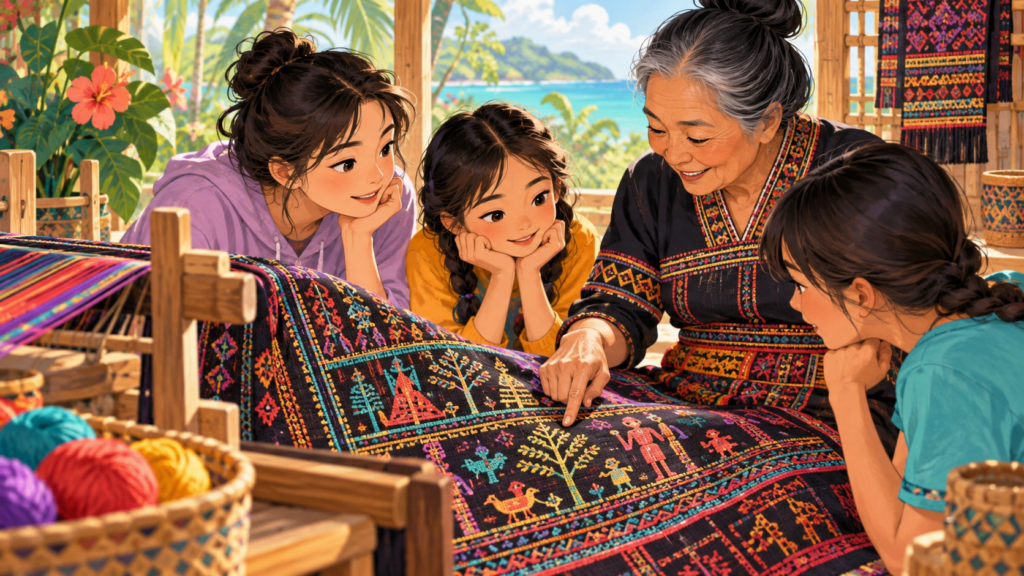
A pattern can be easy to recognise and much harder to understand. You might notice a repeated shape on a piece of cloth without knowing who made it, why that design was chosen or what knowledge went into producing it. Looking closely begins with accepting that those are different questions.
Among Li communities on Hainan, textile techniques bring together practical work and cultural memory. UNESCO’s account describes spinning, dyeing, weaving and embroidery, traditionally passed on by women through demonstration and spoken explanation. Patterns can preserve histories, legends and beliefs, but that does not make every piece of cloth a message anyone can translate at a glance.
Before there is a pattern
The four techniques do different jobs. Spinning prepares thread from fibres. Dyeing changes its colour. Weaving builds the cloth, while embroidery adds stitching to a surface. Thinking of them separately makes a finished textile more interesting, because its appearance is the result of several kinds of decision rather than one quick act of decoration.
UNESCO identifies cotton and hemp among the materials used in this tradition. A maker has to work with the material as well as with a design: a pattern drawn on paper is not yet a pattern successfully made in thread. Repetition requires attention, and a small change can become noticeable when it runs across a larger surface.
The cloth also belongs to everyday life. The account connects these techniques with clothing and other necessities, rather than describing objects made only to sit behind glass. That matters when we look at heritage. Something can be culturally important because people use it, repair it and teach someone else to make it.
A story needs someone who knows it
UNESCO explains that designs helped record community history and traditions through a combination of textiles and oral knowledge. This is a description of a historical means of passing things on, not a statement about the literacy of people living on Hainan today.
It also suggests why the maker’s explanation matters. Seeing a shape is one thing; knowing its place in a particular design is another. An unidentified motif should not be given an exciting invented meaning simply because it resembles an animal or a familiar letter. A responsible interpretation needs someone who knows the technique and context.
The account describes mothers teaching daughters by showing as well as explaining. That combination makes sense for a skill involving hands, timing and repeated actions. Instructions can name a step, but watching lets a learner see how the step fits into the work around it.
Transmission has changed too. UNESCO transferred the tradition to its Representative List in 2024 following safeguarding work. The entry describes wider opportunities to learn, including formal education and the involvement of men. A living practice does not have to remain frozen in one arrangement to retain its value.
For someone encountering a textile for the first time, a good starting point is modest: identify the material, notice the repeated choices and find out what the maker or a reliable account can explain. You do not have to pretend to understand the whole story immediately. The pattern becomes richer when the person who knows it is allowed to speak.
These two textile stories look more closely at thread and the work done with it: How much work is inside a silk thread? and Why does embroidery belong in a modern city?.