
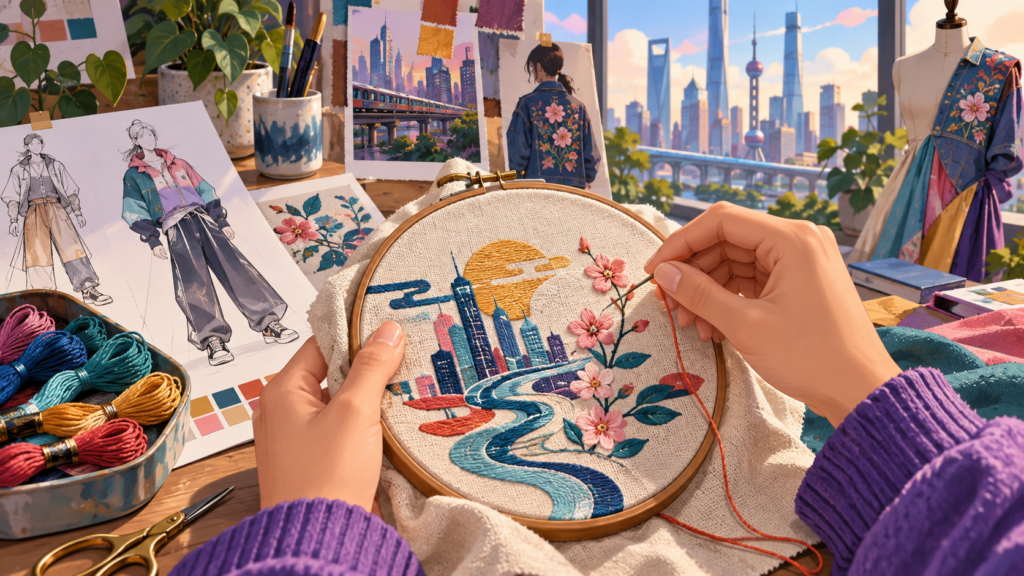
It is easy to divide a city into “old crafts” and “new ideas”, as though a needle could never meet a laptop. UNESCO’s profile of Suzhou lists embroidery, carving, painting and calligraphy among important local traditions. It also describes the city’s aim to connect these skills with fashion, technology and creative businesses.
A goldfish made with a finer thread
Suzhou’s account of Jiangsu Week at the 2025 Osaka Expo names a maker at work: Yu Junyao, demonstrating a goldfish pattern in silk embroidery. The report explains that one silk thread can be split into as many as 128 finer strands. That is a description of a capability, not a claim that every stitch in every Suzhou work uses exactly that division.
The number helps explain something a distant photograph misses. A thread can be treated as material to prepare, rather than simply taken from a spool and pushed through a needle. Its fineness changes what a maker can attempt on a small surface.
A goldfish is a useful subject for noticing those choices. Instead of looking only for a recognisable outline, look at how the stitched surface builds the animal’s form. You can ask which details are carried by colour, which by direction and which by the size of the marks. Those are observations to make of an identified work, rather than an invented account of this maker’s every movement.
The Expo display also included works by the heritage practitioner Yao Huifen. These were contemporary people presenting their work to an international audience. The craft did not have to become a forgotten activity in order to qualify as heritage.
Naming the makers matters. It lets the story remain about skilled people doing something now, rather than allowing “tradition” to absorb their individual work.
The stitch is part of the design
An embroidered surface is made from decisions about thread, placement and the way a stitch catches the light. A drawn idea cannot settle all of those decisions in advance. The person working with the material has knowledge that becomes visible only when the design is being made.
That is why a collaboration should give a craftsperson room to respond, rather than asking them to copy a finished picture without discussion. A designer might propose an effect that works on a screen but behaves differently in thread. Testing a sample can reveal what needs to change.
Scale makes a difference as well. A detail that is effective on a small piece may become difficult or time-consuming when repeated over a larger surface. The intended use also matters: an object made for display and something handled or worn will face different demands.
Suzhou’s UNESCO profile describes ambitions to connect crafts with technology, fashion and other creative work. That is a starting point for asking how partnerships are organised. It does not guarantee that every maker receives an equal say or that every new product is successful.
A fair collaboration would need to consider time and credit as well as appearance. Who developed the method? Who made the finished work? Is the name of the maker visible when the product is presented? Those questions help prevent skilled work from disappearing beneath the name of a brand or a project.
Technology can play several roles without replacing the craft. It might help record a design, communicate with a customer or show details to someone far away. A digital image can make a stitch easier to inspect while the physical making still requires the maker’s decisions.
Learning remains important. A technique cannot continue solely because photographs of it survive. Someone needs the opportunity to practise, receive advice and develop the judgement that an experienced maker brings to the material.
That puts embroidery firmly in the present. It can carry a history while also belonging to a working person’s plans, income and creative ambitions. The interesting question is not whether an old craft is allowed into a modern city, but whether the city makes meaningful room for the people doing it now.
The goldfish’s stitches belong to a maker with a name. That is a better beginning than an opposition between old craft and modern life: somebody working now, using knowledge that still has new things to make.
Explore next
Sources
- UNESCO Creative Cities Network: Suzhou profile
- Suzhou Municipal Government: Suzhou embroidery at Jiangsu Week, Osaka Expo, 26 May 2025