
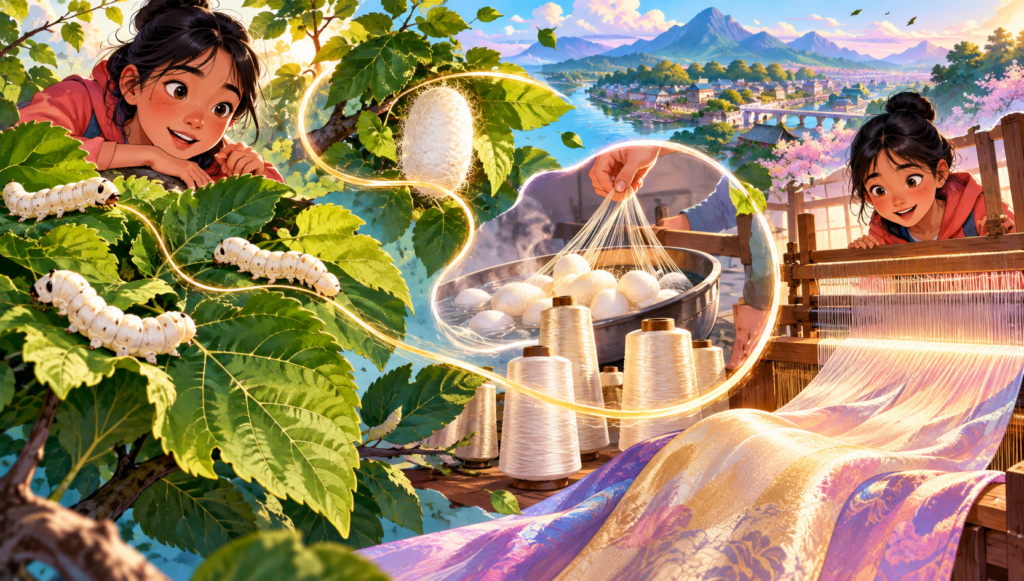
Silk feels like one smooth material. Making it involves a chain: mulberry trees, silkworms, cocoons, reeling, dyeing and weaving, with knowledge spread among different workers. UNESCO’s account of Chinese sericulture treats this as a living craft, not a single ancient trick.
There can be a fish pond behind the fabric
UNESCO’s sericulture account describes a practical connection that a scarf label would never show. Silkworm waste goes into village fish ponds. Mud from those ponds is used to fertilise mulberry trees, whose leaves in turn feed the silkworms. Trees, insects, fish and textile work can therefore belong to a linked production landscape.
The direction of each movement matters. Leaves are food for the worms; mud is returned to the growing trees. These are not interchangeable ingredients, and putting the links in a circle does not make the system run without work. People still have to raise the organisms, move material at useful times and manage the water.
The same need for attention carries into the later stages named in the heritage account: unreeling silk, making thread, designing and weaving. A loom is not the beginning of the material’s history. By the time thread reaches it, earlier workers have already made decisions about living things and useful fibre.
This connection does not mean every silk producer keeps fish, or that every modern scarf comes from a pond-based system. It gives one documented relationship within the wider craft. Following it changes the object in your hand: the smooth surface starts to lead back not just to a workshop, but to leaves, water, feeding and repeated seasonal care.
Skills have to travel too
UNESCO’s account names Zhejiang and Jiangsu near Shanghai, as well as Chengdu in Sichuan, within the practice it describes. Those locations matter. A heritage account of particular communities is more informative than an assertion that every silk-making household in China works identically.
The knowledge is passed within families and through apprenticeship. That means learning is part of the production story. A description of tools and materials would be incomplete if nobody knew how to use them at the right stage.
The stages also demand different kinds of attention. Caring for mulberry trees is not the same task as rearing silkworms. Making thread and designing woven fabric add further decisions. The chain brings living materials and skilled textile work into one process without making them one interchangeable job.
A finished pattern can draw your eye towards the weaving. Earlier stages are less visible because their products have changed form by the time the fabric is complete. Looking backwards restores those contributions rather than treating them as background.
UNESCO also notes women’s important historical role in the rural economy through silk-making. That gives the subject a social history alongside its technical one. It should not become a claim that every worker was a woman or that all households divided tasks in the same way.
The material has had different uses, including clothes, quilts and fans. Each use puts the fibre into a different object. A textile intended to hang or fold does not have to be designed in exactly the same way as something worn on the body.
For a closer look at fabric, separate three questions: what is the fibre, how is it made into cloth and what is the object meant to do? The word “silk” answers the first more readily than the other two. A collection description can help supply the missing stages.
An origin story is appealing because it gives a material a memorable beginning. The living craft is longer than that beginning. It continues wherever people learn, practise and adapt the skills that make a usable thread and fabric. The smoothness you notice belongs to a succession of decisions, not to an invention working by itself.
Follow the thread backwards
Take a scarf in your imagination and unwind its history. Before there was a pattern, somebody managed a living creature and a plant. Before there was a finished fabric, someone had to turn fine fibres into thread strong enough to use.
That is why “silk was invented in China” is an interesting start but a poor ending. It skips the ongoing work and the many communities and techniques within the story. A label that names only the material is rather like a film credit that says “camera” and forgets the crew.
You do not need to own silk to appreciate it. The next time a fabric feels impossibly smooth, ask how many different kinds of patience made that texture possible.
Explore next
Sources
- UNESCO Intangible Cultural Heritage: Sericulture and silk craftsmanship of China