
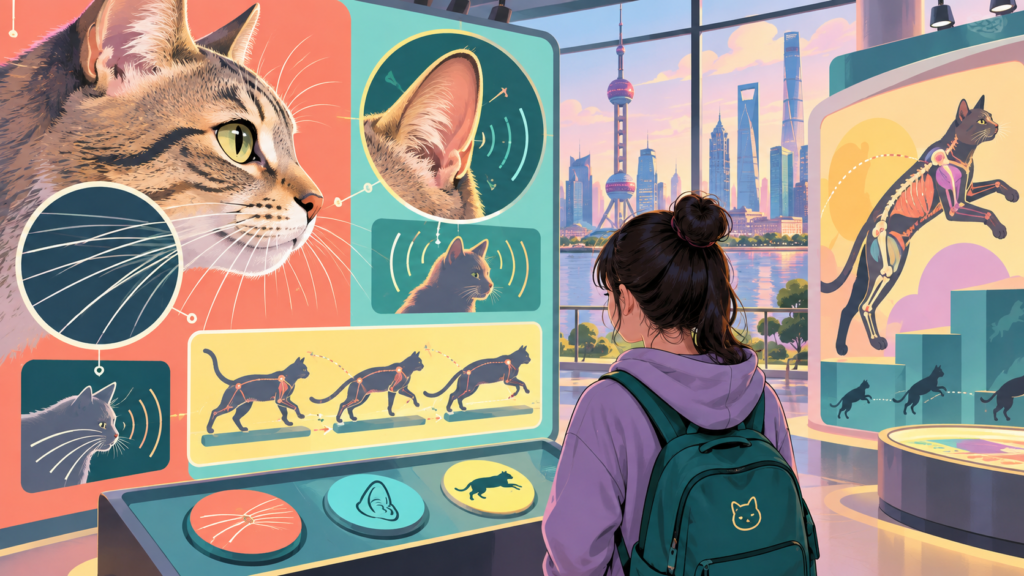
Imagine being told that the school trip is about the history of cats. It sounds like somebody has invented a very good excuse to spend a day looking at kittens. Yet Shanghai’s Miaoum exhibition gives visitors more to do than admire cute faces: the city describes halls about the animals’ origins, their lives as pets and hands-on science displays.
That combination is clever. A cat can be a companion, a subject of science and an animal with needs that do not disappear because it looks lovely in a photograph. A display about hearing or movement could turn the familiar pet on your sofa into something richer and more interesting.
One animal, several sorts of display
Miaoum’s six themed halls range from cats’ origins to their lives as city pets. That gives an exhibition more than one kind of material to work with. A history display asks about change over time; an interactive science display asks visitors to notice or test something.
A picture of a cat in a book provides a different sort of evidence again. The same city guide describes a Shanghai Library exhibition using reproductions from the British Library’s manuscripts, documents and illustrations. Those objects can tell us how people have represented cats, not exactly what a living cat was thinking.
Keeping those questions separate makes the subject richer. A drawing might exaggerate an expression for a story. A science installation should explain the particular behaviour it is demonstrating. Neither needs to be the whole truth about every cat.
The guide also includes a rescue and education venue. That adds the practical work of caring for animals to the cultural and scientific picture. A cat can appear in art, but a living animal still has needs outside the frame.
If you were making a display, you could begin with something visitors already notice: a cat choosing a high place, watching movement or walking away from attention. The next step would be to research an explanation rather than invent one that merely sounds cute.
An interactive exhibit should make that transition clear. What are you observing, what does the explanation say, and what would you still like to ask? An attractive installation can help people begin without making every answer simple.
That is the appeal of the subject. You may arrive knowing exactly why you like cats and leave with a question you hadn’t considered. The animal hasn’t changed between those moments. Your attention has become a little more precise.
The café is not the whole story
The venue also has a cat café. If that is what draws somebody in, fine; the more interesting test is what they notice afterwards. Does a visitor leave understanding why a cat might want space, quiet or a choice about being touched? Those questions matter more than collecting another selfie.
Shanghai’s government guide describes Miaoum as a temporary immersive exhibition in 2026. It does not tell us what every visitor learns, or how each animal responds to a busy room. Both questions deserve room alongside the cheerful photographs.
If you could design one display, what would it ask? Perhaps why cats land on their feet, or what their whiskers actually do. Suddenly a cat exhibition sounds rather like a science museum with better ears.
Two more cat stories move from adoption to a museum-inspired souvenir: Would you adopt a cat instead of buying one? and From Han-dynasty cat to soft toy.
Sources
- Shanghai Municipal Government: Explore cat-themed exhibitions and experiences across Shanghai