
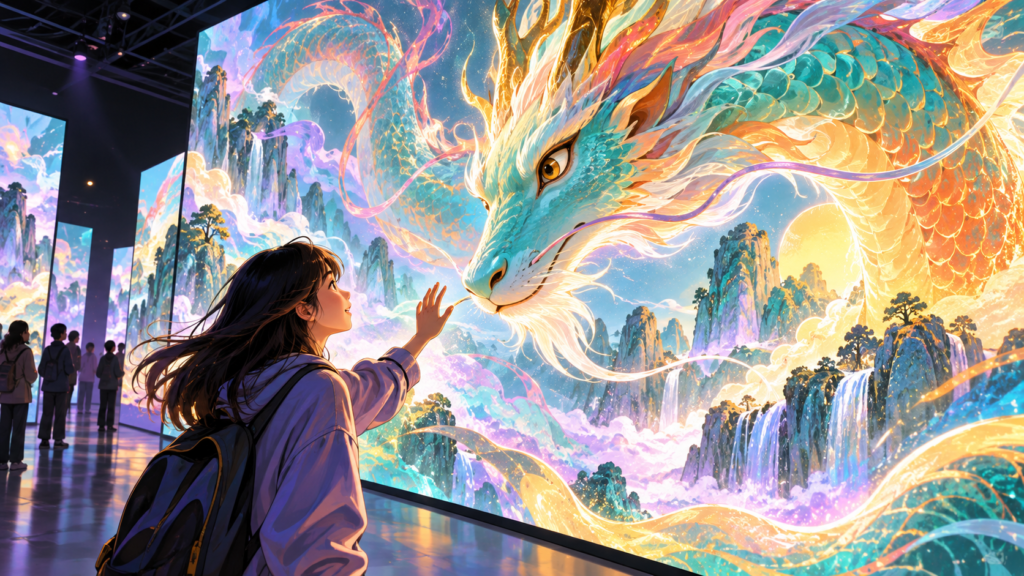
Stand in front of a screen and a creature seems to move towards you. No special glasses are needed. That was part of the idea behind Amazing Zhulong, an exhibition announced for the China Art Museum in Shanghai in 2025, inspired by The Classic of Mountains and Seas, a collection of old Chinese stories and descriptions.
The announced design combined a circular 3D display, light, mist and other effects to make its imagined creature feel enormous. One planned installation, described by the museum’s publicity materials, featured an eight-metre LED dome. It was an artwork made in 2025, drawing on much older material; it was not a window into exactly how ancient readers pictured the creature.
A myth gets a new body
Zhulong is presented in the exhibition as a being connected with light, darkness and the rhythms of nature. That is a rich starting point for visual artists. They can ask what “bringing day” might look like when made from screens, or how a breath might be suggested by moving material. Their answer is interpretation, not proof that there is one official image of Zhulong.
This distinction matters whenever a game, animation or museum display adapts a story. A striking character design can make you want to discover the older version, but the design also adds choices the original story did not make for you. It is fine to like both.
Giving the story somewhere to live
Imagine beginning with the idea of a creature connected to the arrival of daylight. On a page, a sentence can tell you that connection. In a room, an artist has to decide how a visitor will encounter it: perhaps through a change in brightness, a movement or something that seems to look back.
Those possibilities aren’t extra lines recovered from the old text. They are choices made for another medium. A book can let readers linger over a description and build their own picture; a large display offers a picture and asks visitors to respond to it.
The Shanghai announcement described separate areas for scales, breath and an eye. Breaking the creature into those features gives each part a different task. Scales invite attention to a surface, while something suggesting breath could make a visitor notice movement and rhythm. The planned display used those ideas to organise a space.
It is worth noticing how scale changes an encounter. A creature small enough to fit on a page can become an image above or around you. That doesn’t make the larger interpretation more faithful. It makes the experience of looking different.
You could enjoy a striking design and still prefer the creature you imagined while reading. Another person might discover the older material because the design caught their attention first. Neither route requires one version to replace the other.
The useful next step is to ask which parts came from the story and which belong to this artwork. That question lets an adaptation be inventive while keeping its source visible. It also makes room for another artist to choose something else.
A modern show can supply light and movement without supplying the last word on a myth. The older text remains available to read, compare and interpret, beyond the moments selected for the room.
If you sketched your own version, you might start with just one feature. How would you show an eye associated with day and night? You would be making an interpretation too, rather than discovering a photograph of a creature from the past.
Which version would you remember?
The Shanghai design proposed turning an old name into an experience visitors could walk around. Somebody who had never heard of Zhulong might leave curious about the book; somebody else might remember only the light effects. Neither reaction is guaranteed.
If you could design a myth for a screen, what detail would you keep and what would you invent? That question is more interesting than asking whether modern technology has “saved” an old story. Stories were being retold long before there were giant LED walls. The walls are simply a particularly bright way of joining in.
Compare animated folktales with another immersive encounter with the past: When folktales become animation and What happens at a Han-dynasty dinner in VR?.
Sources
- Shanghai Municipal Government: Mythical 3D art display set to debut at China Art Museum