
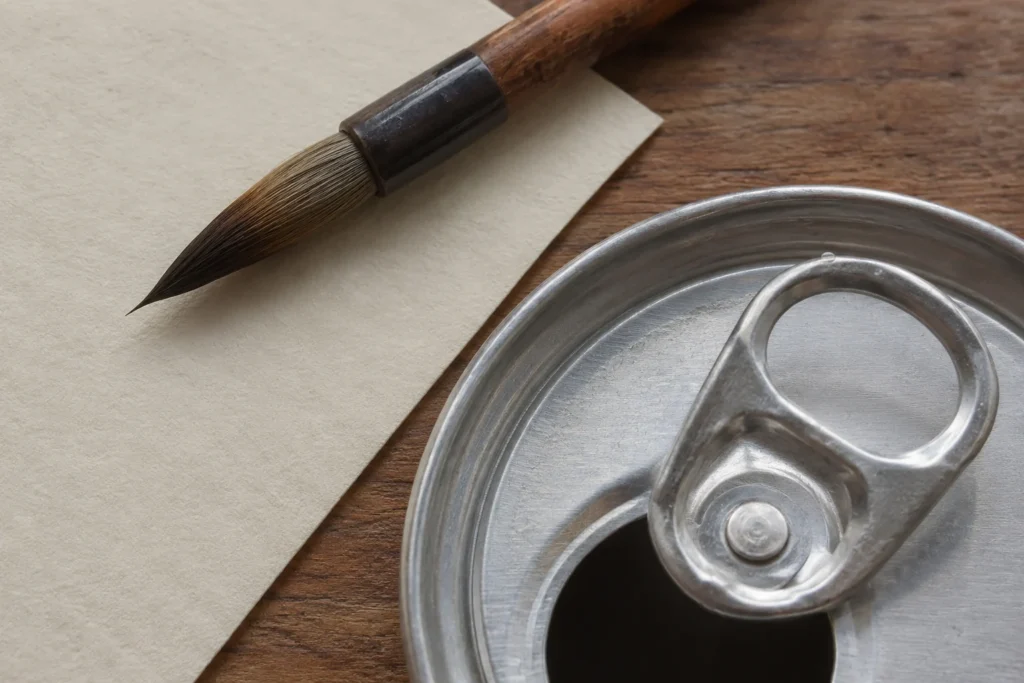
A Shanghai museum souvenir guide in 2026 featured cola cans bearing reproductions of annotations by the Qing emperor Yongzheng. The Minhang Museum product moved historical handwriting onto an everyday container. It offers two routes into the original: how the writing looks, and what its words meant in their earlier setting.
The contrast might make you smile. But after laughing, the next question is what the note says and why an emperor wrote it. An ordinary drink can has accidentally raised a history question.
An unexpected path back to an object
Minhang Museum’s exhibition dealt with objects from the reigns of three Qing emperors. Its shop also offered a craft activity making fuse-bead designs from motifs such as blue-and-white porcelain and phoenix crowns. These are modern interpretations, not old Qing products that have somehow survived in perfect packaging.
The risk with a playful souvenir is that it makes the past look like a collection of cute patterns. The opportunity is that somebody who might pass a display case without stopping takes a second look. Which effect wins depends on whether the museum also tells visitors what the source object or text actually is.
Handwriting without the original page
A copied piece of handwriting can make a historical person seem suddenly present. You can see that someone made marks rather than merely encountering their name in a list of rulers. On a can, the writing appears beside an object whose purpose is thoroughly modern.
To understand one note properly, you would want to know what it says, what it was written on and what the writer was responding to. A comment can mean something different when separated from its page. The original setting helps explain a remark that the handwriting alone can’t.
That distinction lets the can be playful without making it a complete history lesson. Its designer has chosen one aspect to reproduce: the appearance of writing. The exhibition and its supporting explanation can provide a route towards the documents and objects beyond that choice.
Other products in the guide work through a shape or pattern instead. A small porcelain-inspired object might invite you to compare its outline with something in a display case. Writing adds another question because there is a message as well as an appearance.
You could notice the design without being able to read it. Curiosity doesn’t require pretending that you already understand. Asking what the note means and where it came from is a perfectly good beginning.
Would you buy the question?
The can could sit on a shelf long after the drink is gone, making people ask where the writing came from. Somebody else might toss it away without noticing. A clever design cannot force curiosity; it can only offer an opening.
The Shanghai guide includes plenty of less surprising souvenirs, from soft toys to magnets. This one stands out because the distance between an emperor’s note and a cola can is enormous. The gap is where the question lives.
Explore handwriting as a craft and another encounter with museum souvenirs: Can you see how fast someone wrote? and Why are museum gifts turning into plush toys?.
Sources
- Shanghai Municipal Government: Shanghai museums get creative with cultural merchandise