
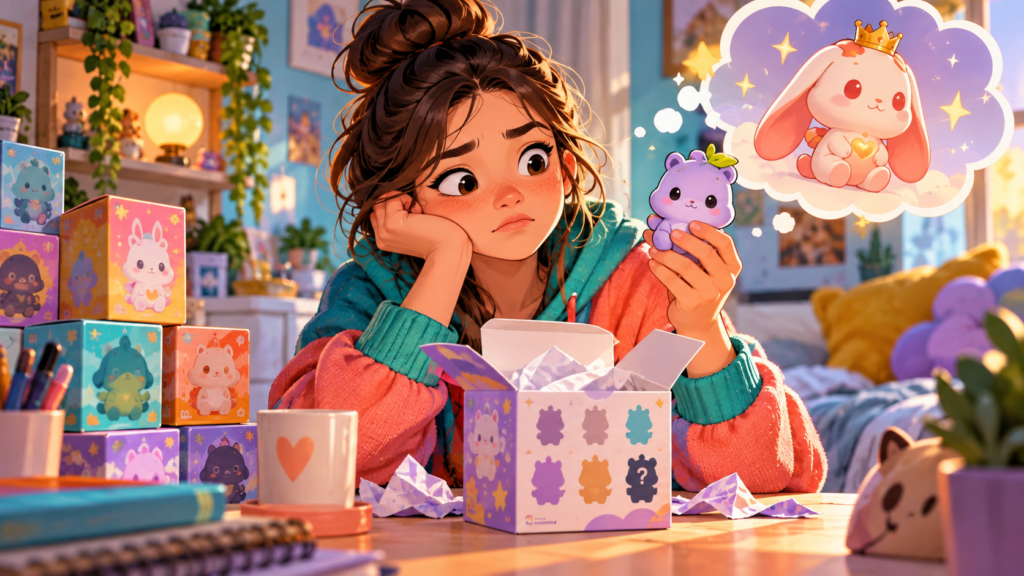
Imagine choosing a small box because you love one of the characters pictured on it. You open it and find another figure from the same series. It may be adorable, but it isn’t the one you were hoping for.
That gap between choosing the series and choosing the exact object is the important feature of a blind box. The packaging tells you something about what you might get while keeping the contents of this particular box out of sight.
Blind boxes appear within the toy scene described in Shanghai’s shops and events. A 2025 My Little Pony event at TX Huaihai, for example, listed plush blind boxes among its products. The international franchise and the Shanghai venue are separate parts of the example; being sold there doesn’t make the characters Chinese inventions.
What are you actually choosing?
With a visible figure, you can decide whether you like that figure before buying it. With a blind box, you need to consider several possible results. Loving one character on the packet doesn’t settle whether you would be pleased with the others.
Imagine a series of four designs, all shown on the packaging. You might like every one, which gives the surprise a different meaning from a situation where you want only one. The number four in this example is invented to make the choice clear; it doesn’t describe the products at the Shanghai event.
The useful question is whether you would still want the box if you knew you could receive any of the pictured designs. If your interest disappears when you think about the other results, the uncertain contents may be doing more work than the object itself.
It is also worth separating a possible result from a promised one. Seeing a figure on a box doesn’t guarantee that it is inside the next box you buy. Without reliable product information, you shouldn’t assume that all results have equal chances either.
You could also choose a product whose contents are visible. That changes the experience rather than making you a less enthusiastic fan: the object itself becomes the reason for the decision.
A collection doesn’t have to be finished
Opening a surprise can be enjoyable. The difficult moment may arrive afterwards, when the figure you didn’t get begins to feel like an unfinished task. A series printed together can make separate objects look as though they belong to a set you must complete.
You don’t have to accept that invitation. One figure you enjoy can be a complete choice on its own. Liking a character isn’t measured by owning every version of it, and somebody else’s collection doesn’t decide the size yours should be.
If you do want to buy something, deciding in advance what you are comfortable spending can keep the decision clearer. Reaching that limit can be the end of the shopping, even if the hoped-for figure hasn’t appeared. Another box doesn’t owe you the result you want.
Swapping with a friend may be an option if you both genuinely want what the other has, but it isn’t something a purchase guarantees. The box only supplies its contents; friendships and future trades aren’t included.
Could the design work without the mystery?
Shanghai’s Art Toys Museum announcement describes a space for emerging designers alongside recognisable franchises. That offers another way into the subject: looking at the design rather than the hidden result.
Which expression, pose or colour would make you choose an object if it were visible? Imagine the same figure in a clear box. You might still love it, or discover that most of your excitement belonged to finding out what was inside. Either answer helps you understand your own choice.
The Shanghai My Little Pony notice described a July–August 2025 event, not one still running now. Its product list is a dated example of how surprise formats can sit alongside other kinds of merchandise.
An unexpected figure might become a favourite. It might not. The nicest version of a surprise leaves room for both outcomes, without turning your shelf into a task you have to finish.
For two further questions about collecting small objects, continue here: Can a toy belong in a museum? and What is guzi, and why do people collect it?.
Sources
- Shanghai Municipal Government: Toy company Hasbro launches My Little Pony festival at TX Huaihai
- Shanghai Municipal Government: Shanghai welcomes first cultural complex for trendy toys