
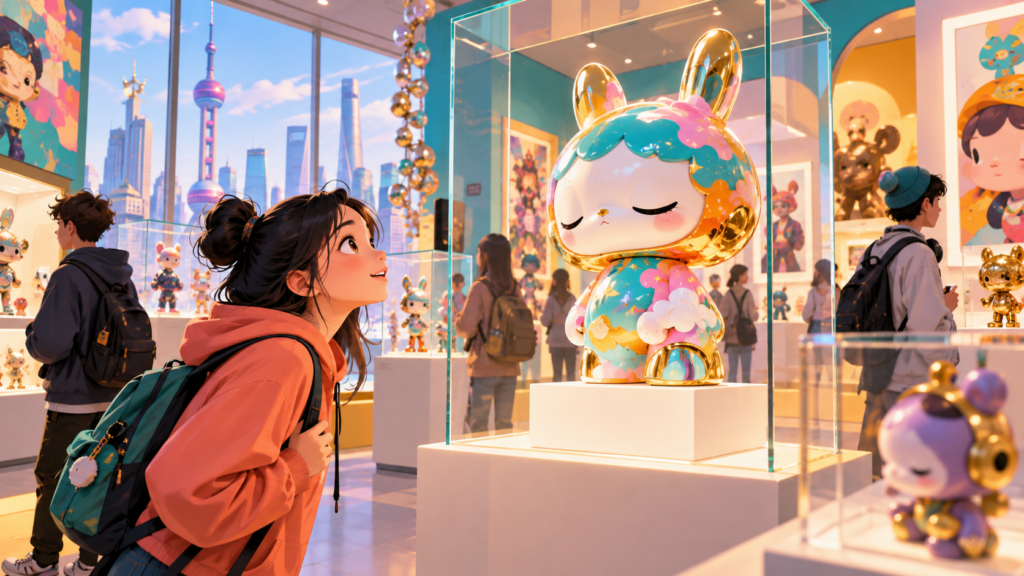
If a small character sits on your desk, you might call it a toy. Someone else might call it a design object, a souvenir or the best thing on the shelf. Putting it in a display case adds another possibility: something worth looking at closely.
Shanghai’s Art Toys Museum opened at the Oriental Pearl Tower in June 2025, according to the city’s announcement. Its themed spaces brought familiar franchises together with an area for emerging designers. A cafe and social space were included, too. The setting gave collectable characters a place to be seen alongside other people’s ideas.
Whether you use the word “toy” or “art”, there is a useful question to ask: what has somebody chosen to make you notice?
Who made the face on the shelf?
Imagine sketching a character with two small eyes and a round head. Move the eyes a little closer together, change their angle or alter the shape of the mouth. The drawing may suddenly look cheerful, uncertain or mischievous, even though very little has changed.
Now imagine turning that drawing into an object you can see from the side and back. You need to decide what continues around the head, how the body sits and whether the proportions still work away from the original view. A familiar-looking figure can contain many small decisions.
That is one reason a display can be interesting even if you don’t want to own the object. You can compare shapes, expressions and colours, rather than looking only for your favourite character. The figure becomes an example of how a maker has approached a problem.
Shanghai’s announcement described a dedicated zone for new designers. That distinction matters: a newly created character and a well-known franchise can arrive with very different starting points. One maker may need to introduce a personality, while another works with something visitors already recognise.
Neither task is effortless. Keeping a recognisable character while choosing a new pose or material is a design choice, too. Familiarity doesn’t make the person who has done that work disappear.
The display is a meeting place
The Shanghai account named international brands and characters, including Disney and Pokemon, alongside the designer work. Those names help explain the mix. Being displayed in Shanghai doesn’t mean every character was created in China.
You can instead see a place where local audiences and makers take part in a pop-culture conversation that travels. A visitor might recognise one franchise immediately and encounter another design for the first time. The connection begins through what is on display, rather than through a single national label.
A social area could give people room to talk about what they’ve seen. That is a possibility suggested by the layout, not a claim that we watched a particular conversation there. The announcement describes what the venue included when it opened; it isn’t a guarantee of its current arrangements.
Looking doesn’t require collecting
It is tempting to turn every display into a list of things to acquire. But looking can have its own purpose. You might decide that an expression is brilliantly designed, learn who made it or compare two approaches to the same character without wanting either on your desk.
Try choosing one object in a photograph and describing what works about it without using the word “cute”. Is it the stance, the colour combination or the way a tiny detail changes the face? You may discover that “cute” was only your first response, rather than the whole explanation.
You could then try a small sketch of your own. That isn’t a claim to reproduce the designer’s work; it is a way to notice how quickly a few marks can alter a character. The decisions become easier to appreciate when you attempt one.
A toy can fit on a small shelf and still reward a long look. Giving it a place in a display doesn’t force everyone to agree about its importance. It gives them a chance to see the choices behind it.
Two more collecting stories ask what makes a surprise or a souvenir appealing: What is a blind box hiding? and Why are museum gifts turning into plush toys?.
Sources
- Shanghai Municipal Government: Shanghai welcomes first cultural complex for trendy toys