
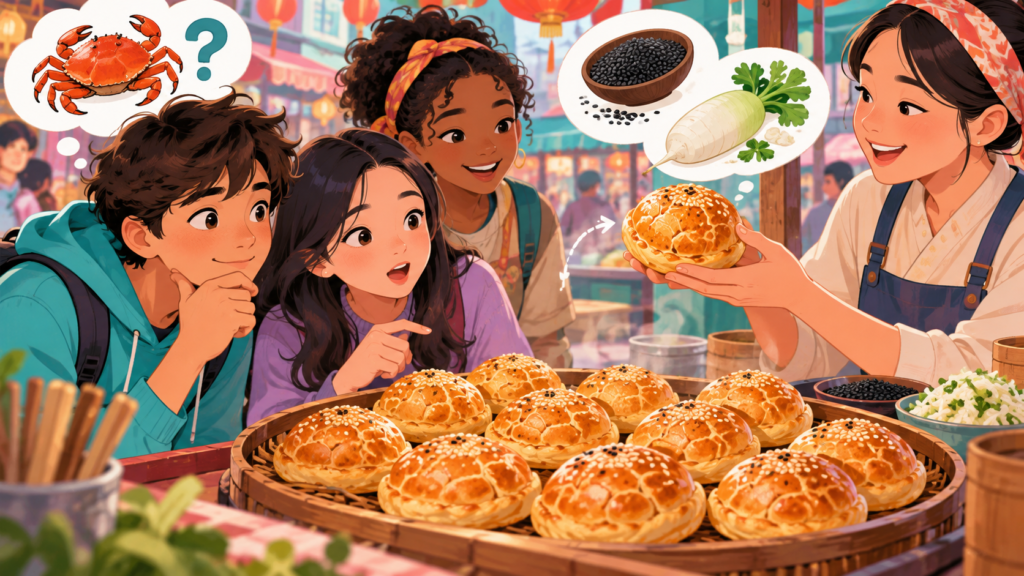
“Crab-shell pastry” sounds like quite a specific order. You might expect crab meat, or wonder whether there is a shell to crack. A Shanghai neighbourhood guide describes something else: a round, golden pastry whose name refers to how it looks.
The guide’s examples near Jialing wet market have black-sesame or shredded-radish fillings. One is sweet and the other savoury. Neither description names crab as the filling, so the word that first catches your attention isn’t the part that tells you which snack to choose.
It is a small reminder of how food names work. They can be precise about one feature while leaving another feature for you to discover.
A name can draw a picture
Here, the rounded form and golden colour are the clues. The comparison asks you to look at the outside, rather than treating the name as a list of everything a cook has put inside it.
Imagine two people reading the same menu. One focuses on “crab” and wonders about seafood. The other has seen the pastry and recognises the shape. The words haven’t changed, but knowing what they refer to changes the picture in your mind.
That can happen with familiar foods in any language. A name might describe where something comes from, how it is cooked or what its shape resembles. Understanding it often involves more than identifying the individual words.
A literal translation can still be useful. “Crab shell” preserves the image behind the name, and once it has been explained, it may make the pastry easier to recognise. The problem would be expecting those two words to do a job they weren’t intended to do.
A photograph beside the name could help you make that connection. It still wouldn’t tell you which filling the maker had chosen for each pastry.
Two fillings, one outside
The Xuhui district account, published on Shanghai’s city website in March 2026, describes black sesame as a rich sweet filling and shredded radish as a savoury alternative inside a flaky crust. The contrast gives the pastry two directions without requiring a new name for each.
What would you ask for? You might like the idea of sesame, or prefer a savoury snack. Choosing between them is about the filling, not about whether you enjoy eating crab. Looking only at the name would have sent the conversation towards the wrong ingredient.
The same guide places these pastries among flatbread, egg pancakes and other snacks near the market. That setting matters because it is a description of one neighbourhood’s food choices. It doesn’t establish a complete menu for Shanghai, or tell us what every stall sells now.
Nor can its two examples prove that every item bearing a similar name has exactly those ingredients. A particular maker may have other versions. The explanation of the name and the information about a product remain separate things.
Keep the picture, check the ingredients
If you avoid seafood or have an allergy, the name’s meaning isn’t a safety guarantee. Ask the seller or use reliable ingredients and preparation information for the exact pastry. An article about a name can’t establish what happened in a kitchen.
For someone curious about food, there is a nicer question waiting after that practical check: what else has the name helped you notice? You might look again at the colour and shape, or compare how two fillings change your expectations of the same crust.
The name hasn’t tricked you once you know what it describes. It has offered a picture. The next useful step is to look inside that picture and ask what this particular pastry contains.
For more food names and another Shanghai pastry, continue here: Can a menu word tell you how food was cooked? and A French pastry with a Shanghai address.
Sources
- Shanghai Municipal Government: A local snack street near Jialing wet market