
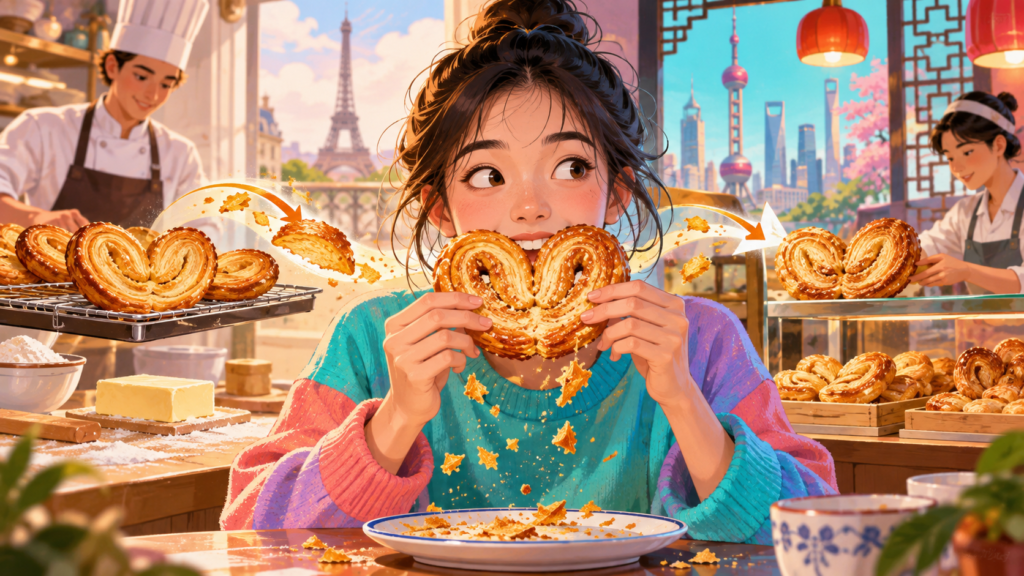
The shape looks like two wings and the crumbs go everywhere. In Shanghai, the húdiésū, or butterfly cracker, is a flaky pastry sold by local bakeries. Its ancestor is the French palmier, but the Shanghai version has its own story of bakers, tastes and habits.
Shanghai’s 2026 food guide says the pastry arrived in the city in the early twentieth century and was adapted by local shops. It describes a less heavily caramelised taste in some Shanghai versions and newer flavours that can even be savoury.
A borrowed recipe is not a photocopy
People sometimes talk about a food as if it must belong permanently to the place where it began. But bakers change recipes to fit ingredients, customers and their own judgement. A pastry can have a French history and a Shanghai life without either cancelling the other.
The layered texture comes from folding the dough repeatedly before baking. That means the shape is only part of the craft; the crisp, fragile bite tells you what happened in the kitchen. Two bakeries can make crackers that look similar and feel quite different.
Look at the broken edge
A whole pastry shows you the butterfly outline. A broken piece lets you look at the layers. The city guide describes rolling and folding dough with butter repeatedly, a process often called lamination. The fragile structure is made before the wings become the finished snack.
The ingredients sound uncomplicated: flour, butter, water and sugar in the guide’s basic description. The work lies in how they are arranged and handled. A list of ingredients doesn’t show you the thin layers or the care needed to keep them distinct.
This is why comparing only the outline would miss much of the pastry. Two versions can have the recognisable double-wing shape while one feels lighter and another has a firmer bite. The guide uses just those sorts of differences when describing individual Shanghai bakeries.
The name changes the picture too. A French palmier points towards a palm-tree form, while the Shanghai butterfly name suggests wings. Those are different ways of seeing a recognisable outline, rather than a disagreement about what the baker has physically made.
Flavour can move further from the familiar sweet version. The guide mentions cheese and seaweed variations, showing that the layered form needn’t always lead to the same kind of snack. A savoury adaptation can keep the technique while changing the expectation.
That makes the pastry’s journey more interesting than an ingredient travelling unchanged from one city to another. Local bakers choose which qualities to emphasise, and their customers have choices among the results.
You can be curious about those differences without requiring a winner. One might suit a particular drink or occasion, while another becomes someone’s regular treat. The food’s history gives it connections; the person eating it supplies a preference.
The crumbs are a useful clue. They remind you that the shape was made from a carefully layered material, not simply cut from one solid biscuit.
Which part travels?
A recipe can cross borders more easily than the exact taste of a bakery. If you buy a palmier in Britain and later try a Shanghai butterfly cracker, you may recognise the outline but notice a different sweetness or texture. That is an invitation to compare, not to score a winner.
The city guide calls the snack an example of Shanghai-style Western pastry culture. It is a useful phrase if we remember the people who made the style: bakers changing a recipe over years, and customers deciding it was worth coming back for.
Two other food histories follow recipes across borders: Can a recipe hold two histories at once? and Is a British Chinese takeaway Chinese?.
Sources
- Shanghai Municipal Government: Butterfly cracker: A French pastry that is quintessentially Shanghai