
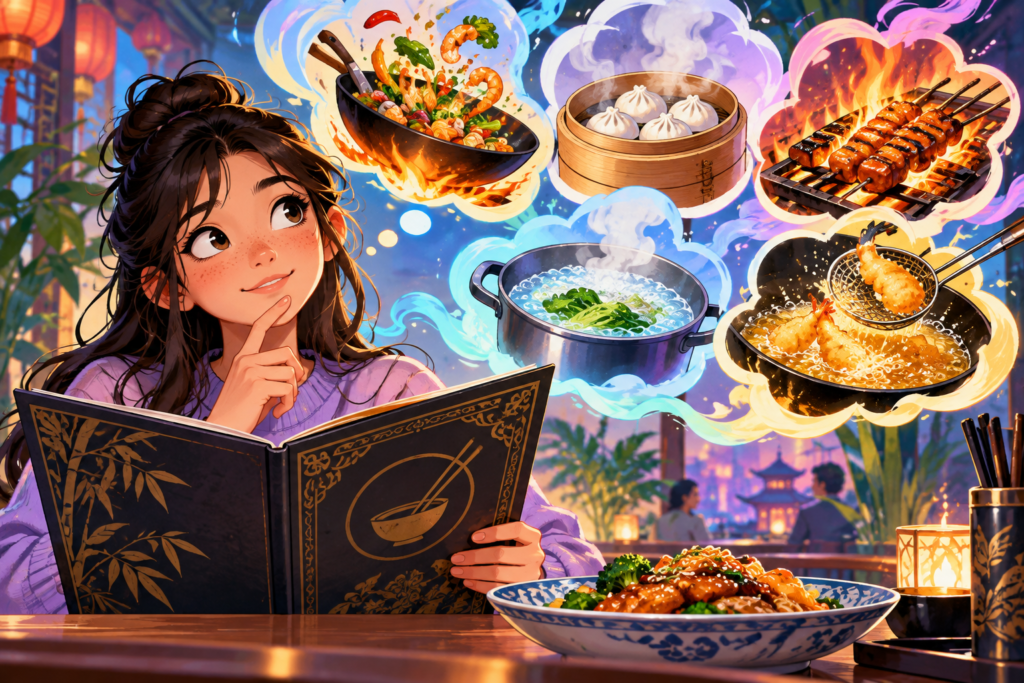
“Chicken with vegetables” tells you the ingredients. Was it steamed, fried, braised or roasted? Those verbs can change the dish far more than a list of nouns. Guides to Chinese menus often begin with food names, but cooking methods are clues too.
Four useful clues
Shanghai’s cooking-vocabulary guide gives several words that help a learner notice methods. 炒, chǎo, means stir-fry; 蒸, zhēng, means steam; 煎, jiān, refers to pan-frying; and 烤, kǎo, covers roasting or baking. These are starting points for reading an action, not a complete cooking course.
The distinction between stir-frying and steaming is easy to appreciate without knowing a recipe. The same ingredient name could appear in both descriptions, while the preparation is different. A translation that includes the action tells you more than one that stops at the ingredient.
炒饭, chǎofàn, is a useful example: the first part supplies the cooking action in fried rice. Instead of learning the whole menu as an unrelated list, you can begin to recognise a familiar element within another word.
Recognising it still leaves questions. The menu may not list every ingredient or describe all the steps. A cooking verb cannot tell someone whether a dish meets an allergy requirement; that needs a clear conversation with the restaurant about the actual food.
Translation also involves choosing a term that fits the dish. An English word such as fried can cover different methods, while a more specific description may distinguish them. The aim is to convey useful information, not to insist that every character has one permanent English equivalent.
A simple way to practise is to make two columns when reading a menu: ingredients and actions. Put what you can identify into each, then leave unfamiliar parts as questions. That helps avoid turning a half-understood word into a confident guess about the plate.
It also gives you something specific to ask. Rather than requesting an explanation of Chinese food in general, you can ask whether a particular dish is steamed or pan-fried, or what the restaurant means by its translated description.
The cook’s work stays central to this approach. A dish is not just a set of objects placed together. It has been prepared through decisions about method, ingredients and timing. Learning a few verbs brings some of that work back into the words on the menu, making the finished food easier to imagine and the next unfamiliar dish easier to ask about.
Read the action
Imagine someone translating “roast potatoes” as just “potatoes”. Technically the main ingredient is there. Practically, you have lost the best bit. Menu translation faces that problem across languages.
This does not mean every unfamiliar word has one perfect English match, or that a learner should guess from a couple of characters. The careful move is to ask a speaker, check the restaurant’s description and notice what the cook actually does.
A menu is a small story about an action in a kitchen. Reading it well can make you curious about the process, not only the final plate.
Explore next
- What would you put in a wonton?
- Is dim sum a single dish?
- What would you eat at a Beijing night market?
Sources
- Shanghai Municipal Government: ten cooking verbs in Chinese