
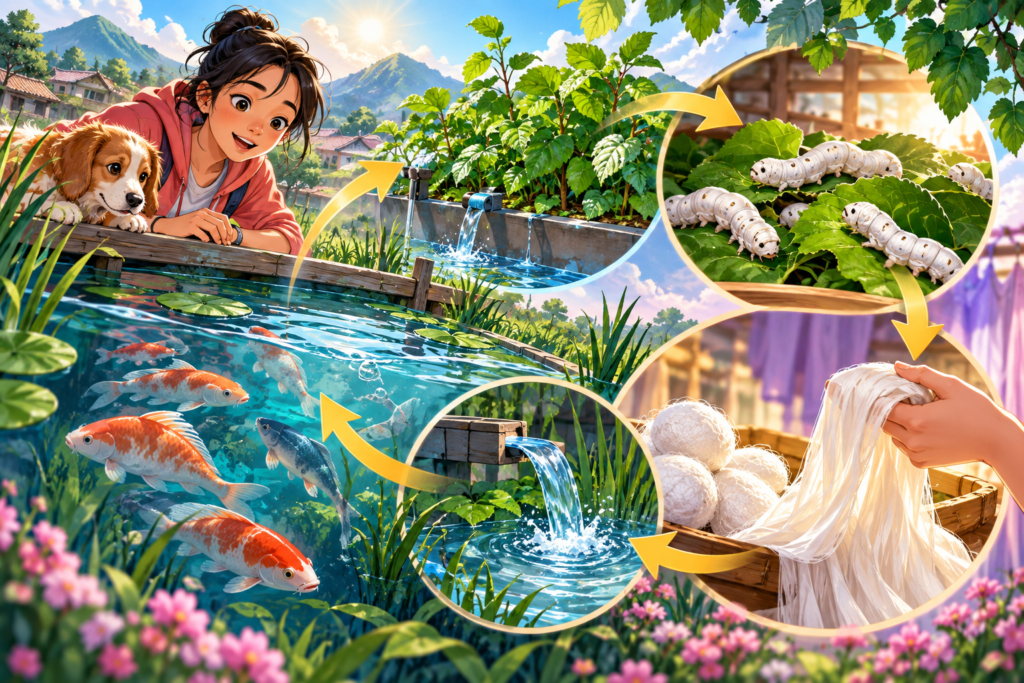
A length of silk and a fish on a market stall do not look as though they have much in common. Around Huzhou in Zhejiang, however, their production has long been connected. The link runs through mulberry trees planted on raised banks, silkworms eating their leaves and fish living in the neighbouring ponds.
This is the mulberry-dyke and fish-pond system recognised by FAO as agricultural heritage in 2017. Its interest is in the arrangements between familiar things. A pond supplies more than somewhere for fish to swim, while the strip of land beside it has more to do than keep the water in.
Start with the leaf
The mulberry leaf feeds the silkworm. The silkworm produces the cocoon from which silk can be obtained, but it also produces waste. FAO describes silkworm droppings being used in the fish ponds and pond mud being returned to the banks as fertiliser. Materials move between activities that might otherwise be treated as separate businesses.
“Fish food” needs a little unpacking here. FAO’s older training manual explains that organic material can support the organisms living in a pond, which in turn support fish. That is different from picturing every fish eating exactly the same thing directly. The manual also describes silkworm pupae left after processing as a possible feed material, so the connection extends beyond the worms’ droppings.
There is a useful distinction between making a product and making use of everything around its production. The cocoon is the object wanted for silk, yet other materials still need somewhere to go. Linking activities can give those materials another use. It does not mean that nothing is wasted or that every farm operates without outside inputs.
The mud has a journey of its own
In the historical practices described by the manual, farmers drained ponds in winter and spread their mud between the mulberry rows. They allowed it to dry before incorporating it into the soil. In summer and autumn, a wetter form of pond silt could be lifted onto the banks after leaves had been picked.
That sequence helps turn an arrow on a diagram into actual work. Mud has to be moved, the trees must be at a suitable stage and the pond still has to function. Returning nutrients is not an invisible process that happens merely because a tree stands beside water.
The manual is a record of farming methods, not a report that every Huzhou farm follows the same calendar today. Its value here is in showing what management involves: different jobs have to meet at the right time. A circular diagram can make the system look instantaneous; a seasonal account reveals the waiting, lifting and planning inside it.
Why arrange the land in strips?
FAO describes a low-lying landscape with waterways running lengthways and ponds arranged across them. Excavated earth helps form the raised banks. The arrangement can retain rainwater and provide routes for surplus water to drain, combining the needs of the planted ground with those of the ponds.
Look at a plan and the land-water boundary is everywhere. That is productive space: the mulberries grow on the banks, while the water beside them supports fish. A larger uninterrupted field would offer a different kind of working area. Here, the relationship between the two surfaces is part of the design.
The fish themselves do not all occupy one identical role. FAO identifies different kinds using different layers of the water. That matters because a pond has depth as well as area. Its living relationships cannot be fully explained by colouring a blue rectangle and placing one fish in the middle.
Follow the materials, rather than looking for magic
The appealing idea is a loop: leaves feed worms, material from rearing enters the pond, and nutrients from the pond return to the trees. The more useful explanation includes the work that keeps those connections possible. Water levels, leaf harvesting, animal care and the movement of mud all belong in the picture.
This is a particular agricultural landscape, rather than a recipe for turning any garden pond into a silk farm. What makes it memorable is how it changes the starting point of two ordinary products. Follow a piece of silk far enough back and you may find yourself thinking about the soil on a raised bank; follow that soil’s nutrients and the next part of the story is underwater.