
Jade is the obvious thing to notice at Liangzhu. A carefully carved object can sit in a museum case under a light, where its surface and workmanship are easy to admire. The water system behind the city is harder to display, but without it the object loses much of its setting.
Liangzhu’s archaeological landscape lies near Hangzhou, in Zhejiang. UNESCO dates the culture represented by the World Heritage property to about 3300–2300 BCE. It brings together city remains, a burial area and water-management structures spread across different parts of the landscape. This was not a collection of impressive possessions lying in an otherwise empty field.
The city did not stop at its walls
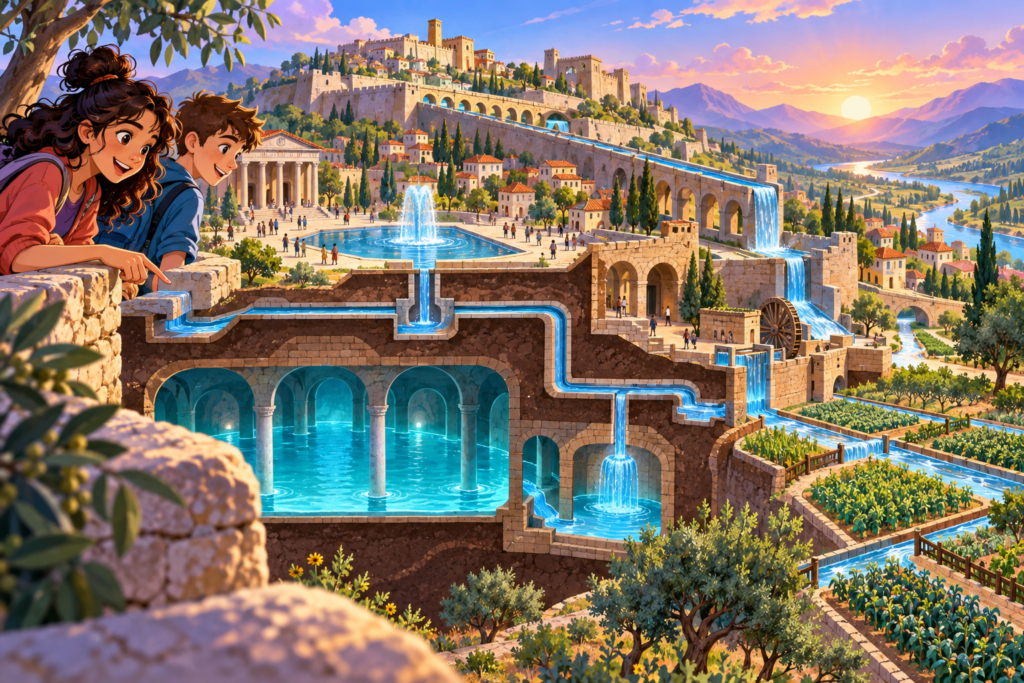
The listed property includes high dams in valleys and lower dams and a causeway on the plain. Their positions matter because water arrives through a landscape rather than appearing neatly inside a city boundary. Understanding the settlement means looking upstream and outwards as well as at its central remains.
Archaeologist Yijie Zhuang’s 2021 study describes a system of high and low dams and the Tangshan embankments. He also places the raised central area of Mojiaoshan within that wider account. It is a useful change of scale: from an object you can hold, to elevated ground, to structures controlling water across a much larger area.
Raising ground and managing surrounding water are related tasks. One concerns the place where people build; the other concerns what reaches that place. A site plan makes that relationship clearer than an isolated photograph of an earthen bank, whose size and position may be difficult to judge.
Rice fields have their own archaeological record
Water management belongs beside evidence of rice cultivation. Growing food and maintaining a settlement are not separate explanations of the city: the settlement depended on a productive surrounding landscape. The agricultural ground needs to be considered alongside the more conspicuous central structures.
Zhuang discusses rice fields excavated at Maoshan in the Liangzhu region. Earlier examples were small, while later fields were much larger, with channels and ditches forming part of their arrangement. The change supplies material evidence for a developing agricultural landscape, rather than simply a general statement that ancient people grew rice.
Larger connected fields raise questions about coordination. A boundary, a channel and a change in field size can show how land was arranged. They do not preserve every conversation about who should dig, plant or maintain it. Archaeologists build an interpretation by bringing those kinds of evidence together.
The difference is similar to looking at a modern school’s plan without its timetable. You can identify spaces and connections, but the drawing does not name every person responsible for making them work. Liangzhu’s structures provide a physical basis for asking about organisation without giving us a complete list of ancient jobs.
Now return to the jade
UNESCO connects Liangzhu’s jade artefacts with belief and social organisation. Differences between burials also provide evidence of social distinctions. A jade object is therefore not merely a beautiful accessory: where and how it was found contributes to its interpretation.
That does not justify assigning its owner a precise modern title on sight. A richly furnished grave and a less elaborate one can be compared; the meaning of the difference has to be considered through the wider archaeological evidence. The setting gives the object more information, but it does not make every answer automatic.
Bringing the water system into the same account helps restore a world around the exceptional finds. People needed food, suitable ground and ways of managing their surroundings before they could make, use and bury the objects we now admire. The earthworks and fields are evidence of those requirements being addressed.
A museum case is only the first stop
A useful way to explore Liangzhu is to move between three kinds of image: an object, a settlement plan and a map of the water structures. The object brings you close to skilled making. The plan shows its urban setting. The map places that setting inside a landscape supplying water and food.
None can replace the others. That is what makes the site more interesting than a display of treasures alone. The jade catches your eye, but the less glamorous remains ask how an ancient city kept functioning long enough for such objects to become part of its history.
Explore next
Sources
- UNESCO World Heritage Centre: Archaeological Ruins of Liangzhu City
- Yijie Zhuang / Journal of the British Academy: Dams, moats, and cities: water management in ancient China, 2021