
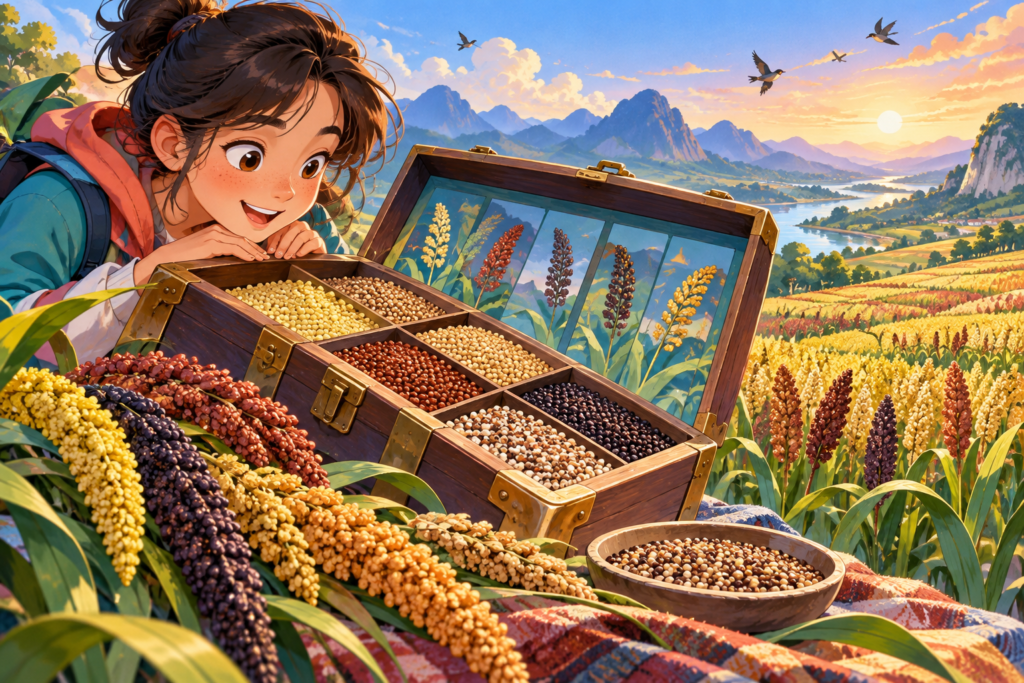
At a supermarket, millet may look like one small bag of grain. In Aohan, Inner Mongolia, FAO recognises a dryland farming system with a long history and crop diversity. Different varieties can matter for different soils, seasons and uses.
More than a seed collection
A label saying millet gives you a starting point, but it does not tell you everything about the crop or the work behind it. FAO’s account of Aohan includes foxtail millet and broomcorn millet within a wider farming system, alongside other crops, forestry and animal husbandry.
The word system matters. This is not simply a display of old seeds preserved apart from daily life. The account describes crop rotation, soil-management practices and knowledge passed between generations. Food production connects the plants with decisions about land and work.
Rotation means thinking beyond what occupies a field at one moment. A field’s next use is part of its story too. FAO gives a sequence involving millet, potatoes, grains and beans as one example; the point here is the planned relationship between crops across time.
Keeping a variety therefore raises practical questions. Who knows when to sow it? How is the harvested grain used? What makes it worth continuing to grow? A seed without that surrounding knowledge preserves only part of what farmers have developed.
Imagine two packets in a collection, each carrying a different name. They might look very similar to someone unfamiliar with them. Recording where they came from and how they were used would help a future grower understand why both were kept instead of treating one as a duplicate.
There is a social question as well. Farming knowledge takes time to practise and teach. Describing it as heritage should lead us to consider the people doing that work, rather than treating a living landscape as a museum that maintains itself.
FAO’s recognition does not mean every older method suits every present-day need. Its account also notes economic and social pressures. Conservation and change have to be considered together, with the people who rely on the land involved in what comes next.
For someone meeting millet in a bowl, all this can seem a long way from lunch. Yet the grain connects a small, familiar act of eating with decisions made across seasons. Looking beyond the generic food label reveals both the crop and the knowledge required to keep choices available.
A choice for tomorrow
If everyone planted exactly one crop variety, a change in weather or a new disease could become a much bigger problem. Diversity is not a guarantee against trouble, but it gives farmers options. Keeping varieties also means keeping knowledge of how and when to grow them.
Imagine a school library that held just one book because it was the most popular this year. It might be convenient today and a terrible loss tomorrow. Seeds can be a library of possibilities too.
This does not mean old farming is automatically easy or better in every respect. It means the food in one bowl can carry local choices that deserve more attention than a generic label on a shelf.
Explore next
- The mudflat where birds stop for lunch
- A panda forest has other residents
- Why do antelope need a route, not just a home?