
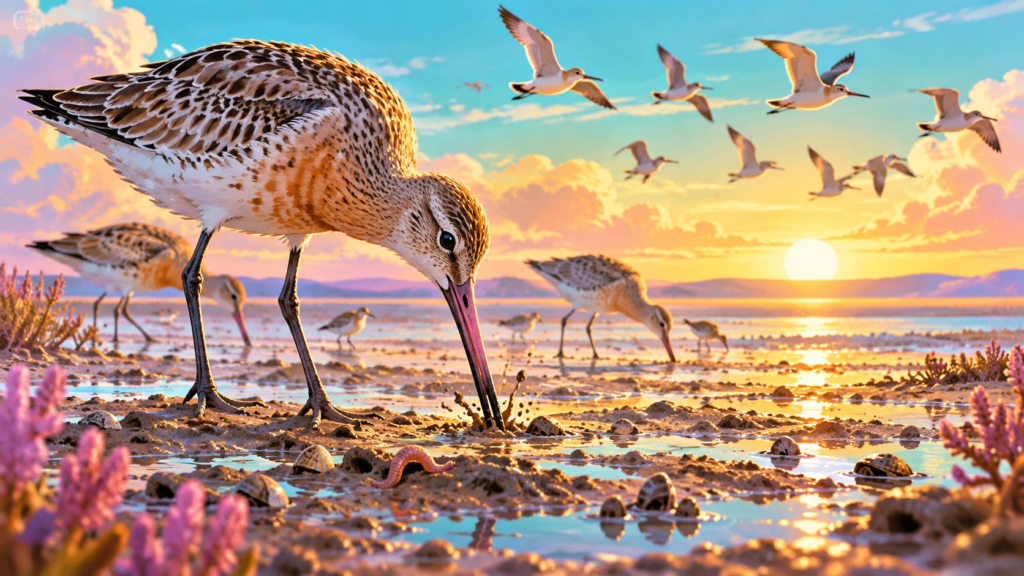
Imagine planning a long journey with no shops, no packed lunch and only a few places where you can stop safely. Migratory birds face a version of that problem. Along parts of China’s Yellow Sea and Bohai Gulf coast, an important answer is a stretch of mud that can look almost empty from a distance.
UNESCO describes these coastal wetlands as essential stopping places on the East Asian–Australasian Flyway, a broad route linking birds’ journeys across many countries. Food found at a stop can help them build the energy needed for the next flight. The middle of the journey matters as much as its destination.
A map might give all its attention to a long arrow. The arrow is much easier to draw than the series of places that makes the flight possible.
A small bird’s much larger journey
Take the Spoon-billed Sandpiper, one of the birds UNESCO names as depending on these tidal flats. Its bill widens at the tip, which explains the spoon comparison in its name. The bird itself is small, but its life connects places a long way apart.
The Cornell Lab of Ornithology describes its breeding grounds in northeastern Russia and its use of coastal habitats during migration and winter. At different stages of that life, it encounters very different ground: breeding habitat in the north and marine mudflats farther along its route.
Cornell’s account also identifies food eaten during migration, including marine worms and shrimp. That makes the supposedly empty mud easier to understand. What matters to the bird may be a small animal beneath or within the surface, not something a person can see from a distant path.
A feeding place is therefore more than spare ground between the land and the water. Its value comes from what an animal can find there when it arrives. Losing it could remove a necessary meal from a journey already demanding plenty of energy.
The tide keeps changing the picture
An intertidal flat is covered and exposed as the tide changes. Looking at it at one moment gives only one version of the place. Water, mud and the living things within them belong to a changing environment.
UNESCO’s account explains that rivers bring sediment into the coastal system, helping form different habitats. The flats aren’t separate from everything farther inland. What rivers carry and how the coastline changes can affect the places the birds use.
That gives conservation a difficult scale. Protecting one area doesn’t make the surrounding water, river system or neighbouring coast irrelevant. A bird can move beyond a marked boundary, and pressures on its habitat can begin beyond that boundary as well.
UNESCO identifies that wider problem alongside the importance of the protected sites. Its account includes changes to rivers, pollution, development and other activity among the pressures to consider. Recognition as World Heritage doesn’t mean those questions have all been solved.
Look for the stops between the arrows
Imagine marking only the start and finish of our sandpiper’s journey. You would have two places worth caring about, but a lot of missing information. Add its stopping places and a different picture appears: the journey depends on a chain of habitats.
That is why an ordinary-looking mudflat can have importance far beyond the nearest town. The bird doesn’t remain within one country’s map for its whole life, and the places that support it need to make sense together. International cooperation is part of protecting that connected route.
You don’t have to find a dramatic landscape to find an important one. A tide going out can reveal a surface busy with food and birds, even if it looked like blank water earlier in the day.
The next time you see an arrow showing an epic migration, look for the small stops. One of the most important places on that map might be the patch of mud that seemed to have nothing happening on it.
Other wildlife stories follow a migration route and the return of a bird: Why do antelope need a route, not just a home? and How did seven birds become a comeback?.
Sources
- UNESCO World Heritage Centre: Migratory Bird Sanctuaries along the Coast of Yellow Sea-Bohai Gulf of China
- Cornell Lab of Ornithology: Spoon-billed Sandpiper Facts: food, range and habitat