
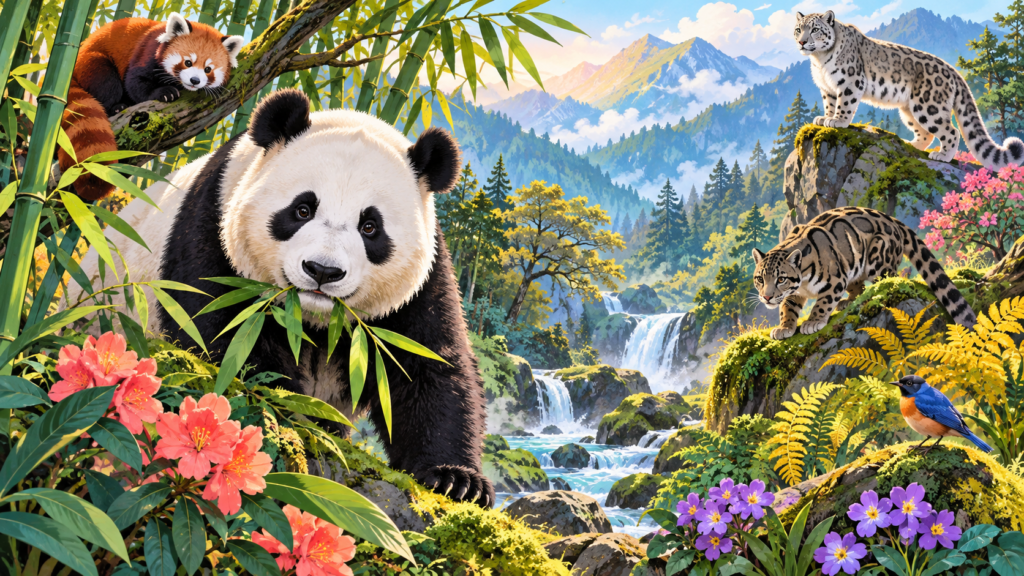
Put a black-and-white panda on a conservation poster and people will stop to look. It is a good start, but the forest behind the animal matters more than the poster. UNESCO’s account of the Sichuan Giant Panda Sanctuaries describes habitat that also supports red pandas, snow leopards, clouded leopards and a remarkable range of plants.
The protected landscape is vast and mountainous. It is not one neat enclosure where all those animals pose together for a photograph. Seeing one animal would not show you every species present, or the whole landscape they inhabit.
The famous neighbour is not alone
A giant panda needs food, shelter and space. Protecting a connected forest can help other animals and plants too, even if they never appear on the souvenir. UNESCO’s description emphasises how rich the area is in plant species, including bamboos and flowers such as rhododendrons and orchids.
That changes the conservation question. If the aim were only to count pandas, it might be easy to forget the place that allows wild pandas to live. The habitat is part of the story, not scenery behind the main character.
A home has to connect
A patch of forest and a connected landscape aren’t quite the same thing. UNESCO’s account raises the problem of habitat fragmentation and the importance of corridors that allow pandas to move. Protecting the place involves looking at how its parts fit together, as well as drawing a boundary around them.
Imagine a map on which several green areas look close together. A road or a developed area between them could make the picture more complicated than the coloured patches suggest. That imagined map isn’t a claim about one particular route in Sichuan; it is a way to see why a conservation description talks about connections.
The plant life gives us another reason to look closely. Bamboo is easy to associate with pandas, but UNESCO also identifies groups such as orchids and rhododendrons. A panda-themed picture might show none of those flowers. Their absence from the picture wouldn’t make them absent from the landscape.
There are different kinds of attention involved here. A photograph of a recognisable animal can make somebody curious enough to begin reading. Understanding habitat asks them to stay with a less easily framed subject: space, connections and the variety of things living there.
A visitor or reader can take that next step without becoming an expert in every species. Choose one of the less familiar residents named in the sanctuary’s description and learn about it separately. Keep its own needs in view instead of assuming it lives exactly like a giant panda.
The distinction also helps when looking at a conservation claim. An increase in attention to a mascot is not, by itself, evidence that every part of its habitat is doing well. To understand the place, we need information about the place.
The poster still has a useful job. It can open the door to a subject that is much larger than the animal printed on it.
Could a less cute animal get attention?
Red pandas have their own fans, and snow leopards certainly do. A tiny plant or insect may have a much harder time winning a poster competition. Yet a functioning forest depends on relationships too complex to fit into one mascot.
You can still love pandas. It is easy to understand why people do. Just let the animal lead you to a second question: what else is protected when its home is protected? Chengdu’s panda keepers even design activities for captive animals, a different setting that should not be confused with life in the wild.
For other questions about wildlife and the space it needs, continue here: Who lives on a mountain above the clouds? and Why do antelope need a route, not just a home?.
Sources
- UNESCO World Heritage Centre: Sichuan Giant Panda Sanctuaries