
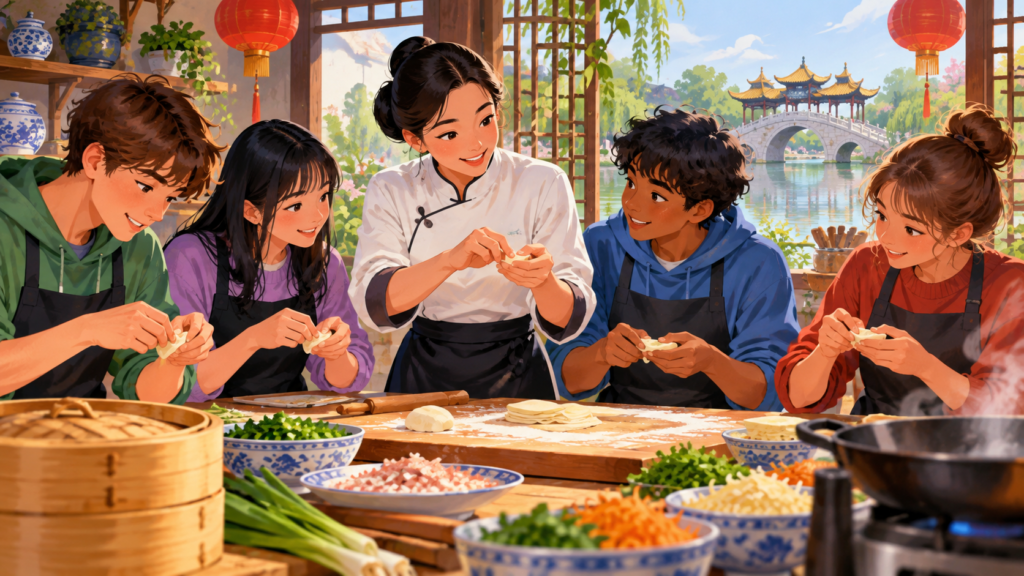
You can read a recipe three times and still wonder what “until ready” means. Yangzhou’s UNESCO Creative City profile presents food as something taught as well as eaten. It describes colleges and training programmes linked to the city’s Huaiyang cuisine, and events where cooks exchange ideas.
A lesson you can see in a bowl
Tofu gives the discussion a real task. In an interview published through Shanghai’s government information office, chef Gao at Gui Hua Lou describes Wensi tofu: soft tofu cut into exceptionally fine strands. He also discusses the stewed dried-tofu shreds associated with Yangzhou. The account concerns Huaiyang cooking in a Shanghai kitchen, not a class we attended in Yangzhou.
These preparations begin with different textures. Keeping very soft tofu in recognisable shreds presents a different handling problem from slicing a firmer, pressed product. “Cut finely” leaves out that difference. The cook needs to recognise what the particular ingredient can tolerate and what shape is wanted in the soup.
The finished bowl can make the skill look almost invisible. Fine strands are the result a diner sees; the movements that kept them from becoming a broken mass happened earlier. A demonstration lets the learner connect the tool, the material and the result.
This is also a useful way to understand adaptation. The interview describes a version of Wensi tofu with sliced abalone. That is one chef’s preparation, not a requirement that every bowl with the name contain the same addition. Understanding the core task allows a cook to explain what has been preserved and what has changed.
A culinary tradition becomes easier to grasp at this scale: one ingredient, one difficult transformation and a person who can show another person how it is done.
What the recipe cannot demonstrate
A written method can say to cut an ingredient finely, but it cannot watch your first attempt. A teacher can notice whether the pieces are uneven and explain why that matters for the next stage. The lesson connects an instruction with something a learner can actually see and change.
That difference becomes especially useful when the method depends on judgement. Ready is not always a fixed number of minutes: the size of an ingredient and the way the equipment is being used can change what happens. Learning to notice the result helps a cook understand a recipe rather than obeying it blindly.
Yangzhou’s UNESCO profile places culinary education alongside Huaiyang cuisine and international exchange. It describes a centre training chefs from abroad as well as local colleges. A skill associated with a place can therefore travel through teaching, without requiring every kitchen to be located in that place.
Teaching across languages makes the practical demonstration valuable in another way. A word such as soft or thin can seem clear until two people compare what they mean by it. Showing the intended result gives them something specific to discuss. Translation helps, but it does not remove the need to look closely.
Training also passes on a sequence. Preparing everything before beginning, checking the stage a dish has reached and recognising when something has gone wrong are parts of cooking that a finished photograph cannot display. The attractive plate is the end of a process, not the whole process.
A learner’s mistake can be informative. If one attempt differs from another, changing only one part of the method makes the comparison easier to understand. That is a useful way to practise under guidance, rather than assuming an unsuccessful first attempt proves that a dish is impossible.
There is room for change within a learned tradition. A cook may adapt ingredients or equipment, but understanding the earlier method helps explain what the adaptation changes. Innovation becomes more meaningful when someone can say which result they are trying to preserve and which they are deliberately rethinking.
Passing on a culinary skill therefore involves more than collecting recipes. It requires occasions when somebody demonstrates, somebody asks and somebody tries again. Yangzhou’s emphasis on training makes that usually hidden work part of the city’s food identity.
The phrase “cut finely” looks small on a recipe page. A bowl of tofu shreds shows how much learning can fit inside it: a material to understand, a movement to control and a result another person can recognise.
Explore next
Sources
- UNESCO Creative Cities Network: Yangzhou profile
- Shanghai Government Information Office: Chef interview on Huaiyang cuisine and tofu cutting