
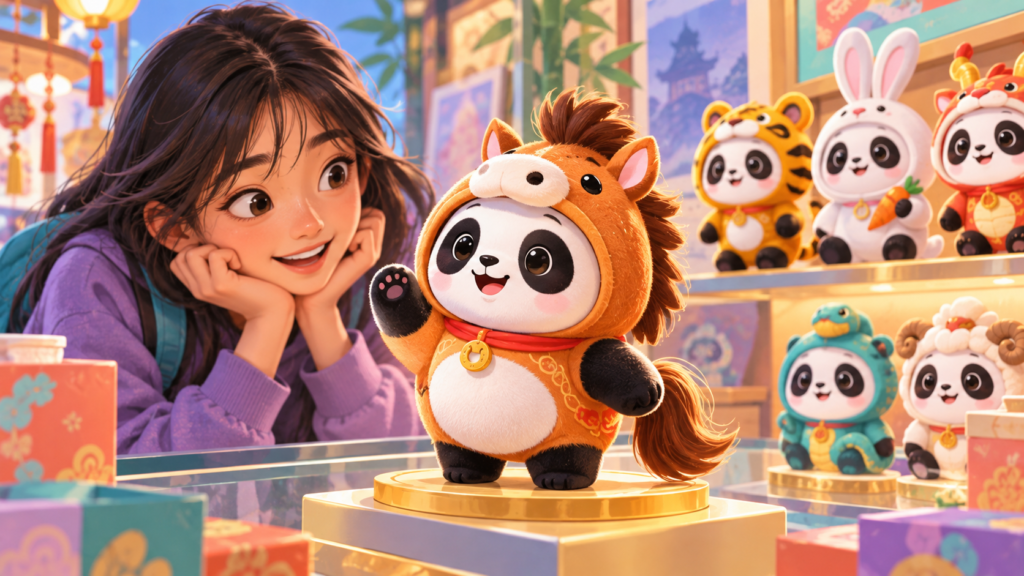
You might recognise Bing Dwen Dwen as the round panda mascot from the Beijing 2022 Winter Olympics. A Beijing city guide to museum souvenirs in January 2026 featured Ma Dwen Dwen, a Year-of-the-Horse design echoing the Olympic mascot’s style. Yes, it is a panda dressed for a different animal’s year. That is exactly why it sticks in your head.
The zodiac gives designers a fresh theme each year, while a familiar character gives people something to recognise instantly. Put the two together and a souvenir can feel new without having to introduce a stranger from scratch.
What has to stay recognisable?
A costume gives a designer room to add details without starting from nothing. The panda’s face supplies the familiar part, while the horse theme introduces a new silhouette and a seasonal connection. Recognition and change are doing different jobs in the same object.
You can test that visually without knowing a brand’s entire history. Cover the costume and ask whether the underlying character still makes sense. Then cover the face and look at the added shape. What tells you which animal the design is borrowing from?
A small keychain has less space to explain itself than a large display. Details have to survive being reduced, while a plush version can use shape and texture. The same idea may therefore look different across products.
The museum guide places Ma Dwen Dwen among other horse-themed designs. That context is useful: the horse isn’t appearing at random. It belongs to a particular festive theme that several institutions interpreted in their own ways.
A character can carry an earlier association and a newer one at the same time. Someone may first recognise the Olympic panda; another may notice the horse costume. Neither response has to erase the other.
If you were redesigning a familiar character for a school event, you would face a similar problem. Change too little and the new occasion barely appears. Change too much and viewers may need the name written underneath. The interesting work happens between those extremes.
That doesn’t make every new version something a person needs to own. Looking closely can be enough. The costume offers a small design puzzle: which details are replaceable, and which ones are doing the hard work of keeping the character itself?
A character you can carry
The city guide included plush toys, badges, keychains and fridge magnets. The range matters because mascots do not stay in stadiums. They move into bags, bedrooms and the small objects people use every day.
There is a less cuddly question, too: when does collecting become pressure to buy every new version? A clever design should be enjoyable even if you never complete a set. You can look at the character, spot the changes and decide which version tells the best visual joke.
The guide describes products for a particular Spring Festival, so availability and prices should never be assumed later. What remains interesting is the design trick. How much can you change a character before it stops being itself? Ma Dwen Dwen suggests the answer might include ears, a costume and a very recognisable panda face.
Explore a calendar tradition and another story about museum souvenirs: Is your zodiac sign a calendar? and Why are museum gifts turning into plush toys?.
Sources
- Beijing Municipal Government: Year-of-the-Horse museum souvenirs, 10 January 2026