
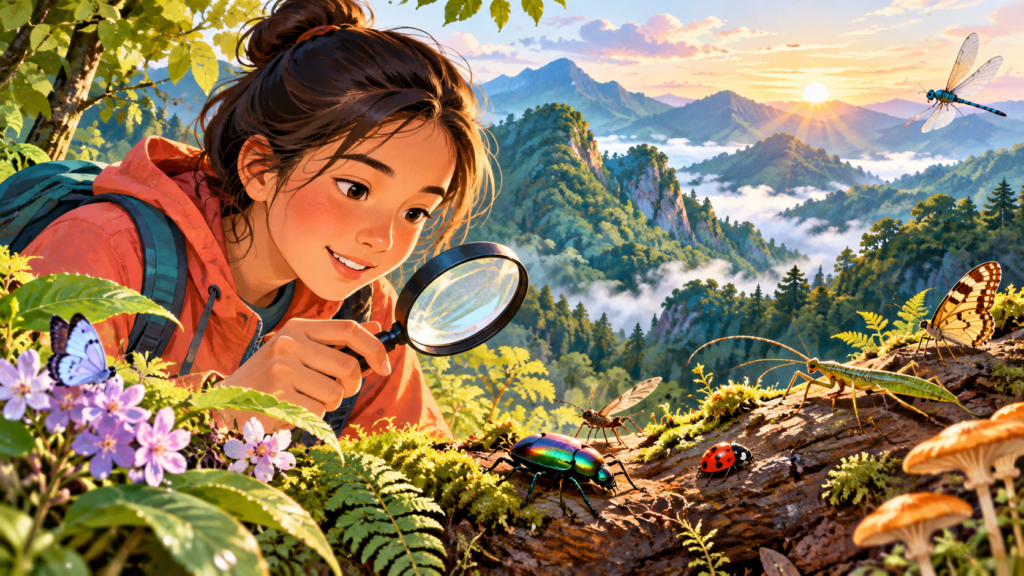
If you visit a mountain, you may look for a huge view or a large animal. UNESCO’s account of Hubei Shennongjia points to a smaller world as well: thousands of insect species have been identified in the protected area.
That does not mean you need to memorise a list. It means every leaf, fallen branch and patch of damp ground can be part of a different life story. Some insects pollinate plants; others break down dead material or become food for birds. The forest works through many small jobs.
What belongs in the catalogue?
UNESCO’s listing account records 4,365 identified insect species. That number counts kinds of insect, not individual insects. Thousands of individuals of one species would still add only one entry to the species list, while a single correctly identified example of a different species could add another.
The distinction matters because a busy patch of ground and a diverse patch of ground are not necessarily the same thing. Seeing many insects tells you that many individuals are present. Working out how many species they represent requires closer investigation.
Shennongjia provides many different settings for that work. The account describes vegetation changing across heights, from broadleaved forests towards conifers, scrub and meadow. An insect’s surroundings can therefore be much more specific than simply “a mountain forest”.
A leaf surface, a fallen branch and the ground beneath them offer different things to investigate. You do not have to name every insect to notice that the places are not interchangeable. Some evidence may be a mark or a movement rather than an animal that stays still for a photograph.
The library comparison becomes useful here. A catalogue helps researchers organise what has been recorded; it does not make every entry equally easy for a visitor to find. Nor does a familiar-looking insect necessarily identify itself without further examination.
The plants and larger animals are part of this story too. Their habitat includes small organisms and the relationships between them, rather than a separate insect collection arranged beside a separate mammal collection. Protecting the setting keeps more of those relationships available.
The UNESCO account also raises the need for connections between parts of the protected area. That adds a second scale to the picture: you can study something tiny and still need to understand a large landscape. A single square metre is a useful beginning, but it cannot stand for every height, season and habitat on the mountain.
The tiny detective challenge
Spend five minutes looking at one square metre of ground. How many different shapes move through it? How many leave evidence without being seen? You can do this at home without collecting or harming anything. Then imagine repeating the exercise across a mountain with different heights and habitats.
UNESCO also records many birds, mammals and plants at Shennongjia. A rich insect world does not stand apart from them. It helps explain why protecting varied habitat matters more than saving one photogenic creature.
The number of identified species is a record of research, not a final count of everything alive there. That is the exciting part: even a place scientists have studied can hold more questions than answers. A mountain may be too large to see in one view, and too full of tiny lives to fit in one notebook.
Compare these two other accounts of mountain landscapes and their living habitats: Where forest and history meet and Who lives on a mountain above the clouds?.
Sources
- UNESCO World Heritage Centre: Hubei Shennongjia