
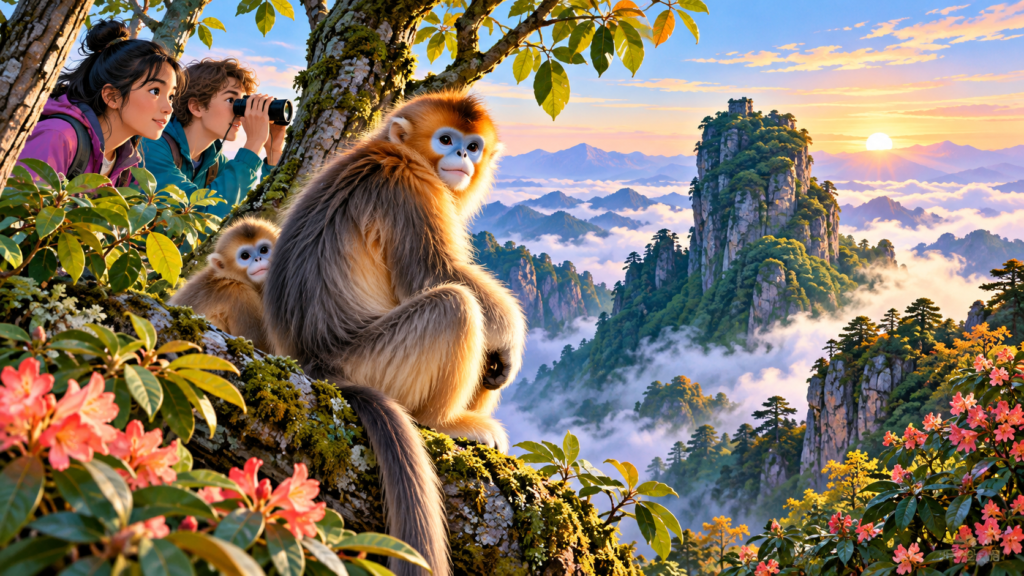
A photograph of Fanjingshan can make the summit seem like the whole mountain. Rock rises above the cloud, and the eye follows it upwards. Yet much of the life that makes this place important is spread across the slopes below that dramatic outline.
The UNESCO-listed protected area in Guizhou ranges from about 500 to 2,570 metres above sea level. That difference in height creates more than a long climb. It brings together changing vegetation and habitats, including places associated with species such as the Guizhou snub-nosed monkey and the Fanjingshan fir.
A mountain changes as it rises
UNESCO’s description moves from evergreen broadleaved forest lower down through mixed forest to conifers and scrub higher up. The useful idea is the change across the mountain, rather than imagining one forest repeated from the bottom to the top.
Plants growing in different parts of the area encounter different conditions. A habitat is therefore more specific than “somewhere on a mountain”. Height, the surrounding vegetation and the relationship to neighbouring areas all help define the place an animal or plant can use.
That makes a summit photograph a very incomplete wildlife map. It may show the most recognisable rock, but not the patches of forest or connections that matter to an animal moving through the landscape. Seeing very little wildlife in a photograph says almost nothing about how much ecological work the place is doing.
The rock adds another distinction. Fanjingshan is a mass of metamorphic rock within a region associated with karst landscapes. UNESCO uses the idea of an island of one type of rock among another. This is a geological comparison, not a claim that the mountain is surrounded by an actual sea.
A familiar outline can therefore sit within a much less familiar setting. The interest is not only that the mountain looks distinctive, but that its geology and habitats differ from those around it.
Where the mountain connects
The protected area’s conservation story includes connections between habitats. An isolated patch of suitable vegetation and a connected area are not necessarily equivalent for the life using them. The spaces between the best-known locations can matter as much as the locations themselves.
Water provides another connection. The mountain’s headwaters feed the Wujiang and Yuanjiang river systems, which belong to the wider Yangtze basin. Rain falling in an upland landscape can therefore be part of a story extending far beyond the summit view.
This is why a place can have several meanings at once. To someone looking at a photograph, it might be a striking mountain. To a conservation account, it is a collection of habitats and locally distinctive species. To an account of the rivers, it is also somewhere water begins its journey.
None of those perspectives guarantees that a visitor will see a particular animal. Wildlife is not a scheduled performance, and a species’ presence in a protected area does not make every path a viewing point. Appreciating the habitat can be worthwhile without turning a visit into a checklist of sightings.
The clouds will still draw your eye towards the summit. Once you know a little more, though, they no longer hide an empty slope beneath a landmark. They hide forests, changing conditions and connections that make the mountain a place to live, as well as a place to look at.
Two more forest landscapes show why a mountain deserves a closer look: Why is a mountain also a library of insects? and Where forest and history meet.
Sources
- UNESCO World Heritage Centre: Fanjingshan