
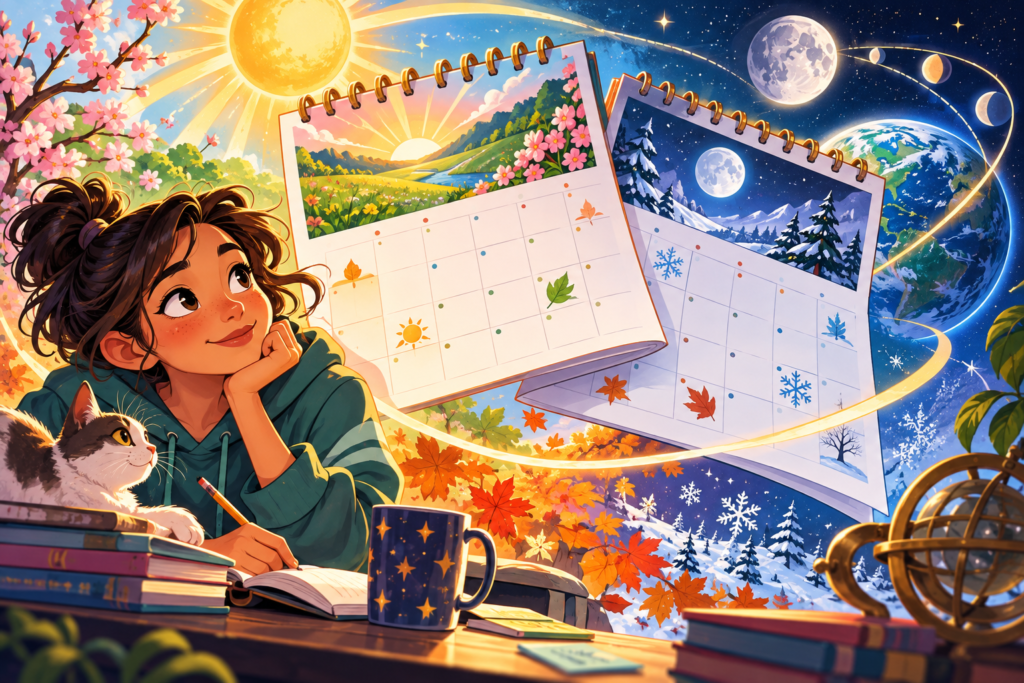
If a festival happens every year, why does its date change on the calendar hanging in a British kitchen? The Chinese traditional calendar and the Gregorian calendar organise time differently. A new year that follows a rule in one system therefore falls on different numbered days in the other.
The moon and the seasons have different rhythms
The Hong Kong Observatory describes the traditional Chinese calendar as an integrated lunar and solar calendar. That distinction matters: calling it simply lunar leaves out the work of keeping its months connected with the seasons.
A month begins with a new moon. The Observatory gives the average interval between new moons as about 29.53 days. Twelve such intervals add up to roughly 354 days, whereas a solar year lasts about 365 days. The gap is large enough to matter when you repeat the calculation year after year.
Without an adjustment, a calendar made from those twelve months would gradually move through the seasons. The traditional system deals with the difference by adding a leap month in some years. That is a whole extra month, unlike the extra day familiar from a Gregorian leap year.
The result is a calendar doing two jobs together. Its months remain related to the moon, while adjustments keep the year connected with the solar cycle. You do not need to calculate those adjustments yourself to understand why the date cannot be copied straight from last year’s school diary.
The festival remains the first day of the first month in its own calendar. From a Gregorian viewpoint, however, it appears under a different combination of month and day. Nothing has moved randomly; the two systems divide the same passing time in different ways.
This is why a calendar conversion is more useful than a rule of thumb. If you are planning a club celebration or writing about a particular year’s event, look up that year and name the calendar you are using. Do not assume that adding 365 days to the previous festival will give the right answer.
It also helps to separate the calendar date from a public event. A parade, school activity or weekend gathering may be arranged around people’s availability. That occasion can celebrate the festival without taking place on the first day itself. An event listing and a calendar entry answer different practical questions.
Learning the reason for the changing date turns an apparent inconsistency into a useful piece of astronomy. The moon does not complete twelve cycles in exactly one solar year, and a calendar has to decide how to handle that mismatch. The traditional Chinese calendar makes that decision visible.
Two rulers for the same time
Imagine measuring your height in centimetres one day and inches the next. You have not changed; the numbers have. Calendars are much more complex than rulers, but the comparison explains why “moving” may depend on which system you are looking at.
The Hong Kong Observatory publishes information about the Chinese calendar and its relationship with Gregorian dates. Check a specific year instead of guessing from last year’s celebration. The important lesson is that a calendar is a way of organising time, not time itself.
Explore next
- The lantern that asks a question
- Are festival rice balls always sweet?
- Is a red envelope just pocket money?
Sources
- Hong Kong Observatory: Chinese calendar information
- UNESCO: Spring Festival practices