
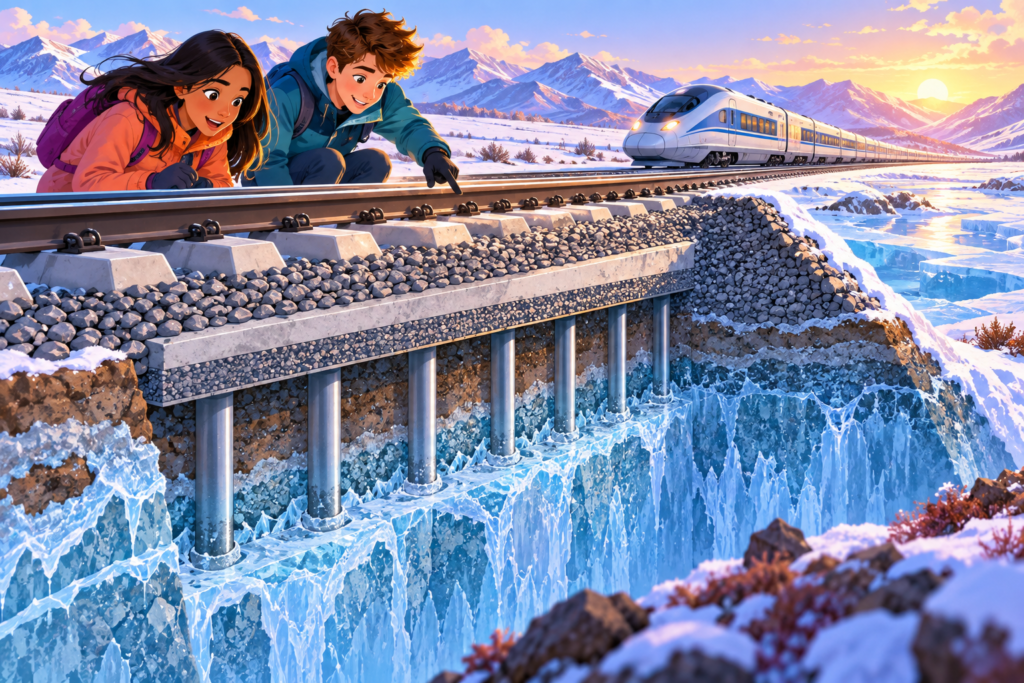
Frozen ground can seem like a solid place to build. But permafrost becomes a difficult foundation when temperature changes affect its strength and shape. Engineers working on the Qinghai–Tibet Railway have had to think about how heat moves between track structures and the ground beneath them.
A foundation with a temperature
The track is a line on a map, but its support is three-dimensional. What lies underneath can matter as much as the rails above. In ground containing ice, a change in temperature can alter the foundation that the railway was designed to use.
A review in Engineering examines this problem along the Qinghai–Tibet Railway, using the name Qinghai–Xizang Railway. It considers both climate warming and the effects of construction. Building an embankment is itself a change to the ground’s surroundings, so the engineering question cannot begin and end with the regional weather.
The review discusses cooling methods, including structures made with crushed rock and devices called thermosyphons. In simple terms, their purpose is to influence how heat moves and help keep the underlying permafrost stable. The researchers also explain why changing conditions require continued adaptation.
This gives maintenance a different meaning from fixing a visibly broken rail. Monitoring temperatures and deformation can be part of understanding whether the support beneath the railway is behaving as expected. The important work may concern a change too slow or too small to appear in a passing passenger’s photograph.
A useful way to think about the challenge is to separate a structure’s shape from its environment. A design may be carefully calculated, yet those calculations depend on assumptions about the ground. If the assumptions change, engineers have to revisit the relationship rather than simply admire the original design.
That does not mean a research discussion of long-term risk is an announcement that a particular train is unsafe today. It means infrastructure has a life beyond construction, during which conditions, evidence and maintenance requirements can change. Keeping those timescales distinct makes the story more accurate.
It also explains why one solution cannot automatically be copied along an entire route. Different sections can present different ground conditions. An approach that works in one setting has to be assessed before being treated as the answer somewhere else.
The railway offers an unusually clear example of a general engineering lesson: foundations are not just materials beneath a building or track. They are materials in a particular environment. Understanding that environment is part of keeping the structure useful, including after the opening ceremony is over.
The problem under the track
Imagine placing a ruler on a block of ice, then letting one part soften. The ruler may tilt even if it was perfectly straight to begin with. A railway requires far more exact engineering, but the simple picture shows why the ground cannot be ignored.
The route is often presented through mountain views and altitude records. Those views hide monitoring, maintenance and the long-term challenge of changing temperatures. Climate change can make yesterday’s design assumptions less reliable.
The cleverest railway story may not be the train speeding past a camera. It may be the invisible work that keeps the track where it needs to be.
Explore next
- Why do antelope need a route, not just a home?
- How would you explore a city by bike?
- Why are there lakes in a desert?