
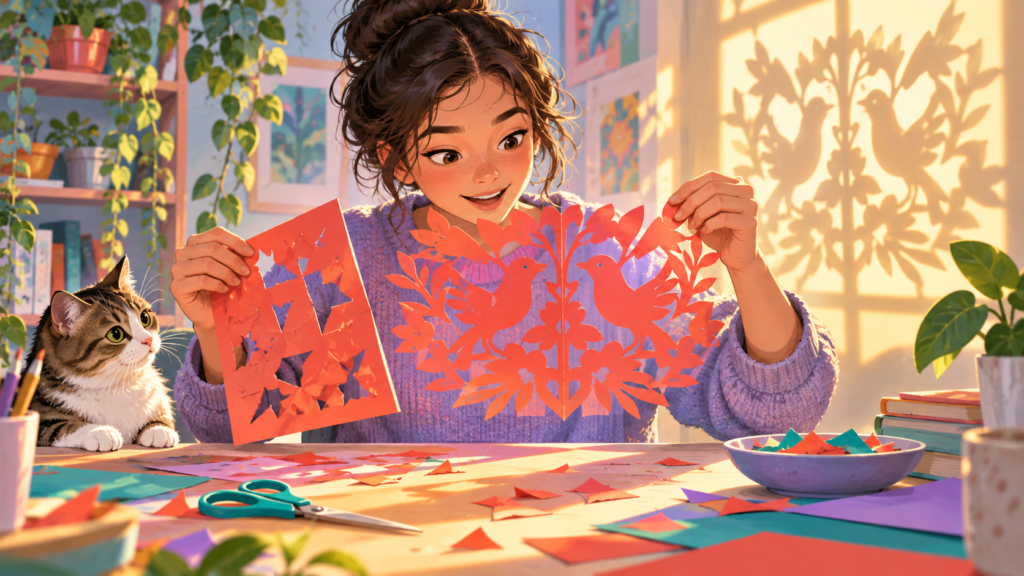
If you fold paper and cut a few shapes from it, the holes may not look promising at first. Open it up and a pattern appears. The empty spaces matter as much as the paper you kept. This is one reason Chinese paper-cutting can be so satisfying to look at: it asks you to see a design in both directions.
UNESCO describes paper-cutting as an art used in different communities and for different purposes, including windows, celebrations and home decoration. Some pieces are cut with scissors, others engraved with a tool. Designs vary by maker and region; there is no standard dragon or flower that everybody is required to produce.
A window can become a gallery
A paper design on a window has a second partner: light. In the daytime, the outside world shows through the cut spaces. At night, light from inside can make the shape visible from the street. The design has not changed, but where you stand changes what you see.
UNESCO’s account notes that paper-cutting has often been passed from women to younger family members. That is a description of a history and a practice, not a rule about who is allowed to make one now. People also use newer tools and techniques.
Designing the part that isn’t there
Picture a drawing of a flower. You can sketch a petal wherever you like because the pencil mark stays on the page. Cut the same outline from a single sheet and a new question appears: what will hold the petal in place? A narrow connection that barely attracted attention in the drawing can become essential to the finished piece.
The background changes too. In a pencil drawing, the space around the flower is simply another part of the paper. In a paper-cut, some of that space can be removed. The shape of a gap may help describe a stem or separate two petals without adding a single new line.
Try looking at a finished design twice, first following the paper and then following the openings. You may notice that an empty patch has a shape of its own. Calling it empty doesn’t mean the maker left it unplanned.
Folding is one way to experiment with repetition, but it shouldn’t make us assume that every Chinese paper-cut is a folded, symmetrical pattern. UNESCO describes several techniques and motifs devised by individual artists. The maker’s decisions matter alongside the place and purpose of the piece.
A design meant for a window also has to be seen against what lies beyond it. A busy view might make a delicate shape harder to pick out than a plain background would. You can test that idea with a simple cut-out held against different surfaces, without claiming your experiment explains every artist’s method.
Colour gives you another choice. UNESCO notes that pieces may be coloured or left blank. Neither option makes the negative spaces disappear; the relationship between the remaining material and the openings still does the work.
Once you begin seeing those choices, the craft becomes more than an attractive decoration. There is a small piece of engineering inside the picture: enough paper must remain for the image to survive being lifted from the table.
Try the question before the scissors
What should remain connected so your design does not fall into separate pieces? That is the puzzle to start with. A bird’s wing, a letter or a tiny bridge between shapes can keep a whole scene together.
You do not need to claim that your first attempt is “traditional Chinese art” because you borrowed the idea. You can appreciate a craft by seeing how skilled its makers are, and then try your own pattern with credit and curiosity. A sheet of paper makes the first lesson wonderfully inexpensive.
Two other craft traditions work with cut shapes and patterned cloth: How many people move one shadow? and Can a pattern tell a family’s story?.
Sources
- UNESCO: Chinese paper-cut