
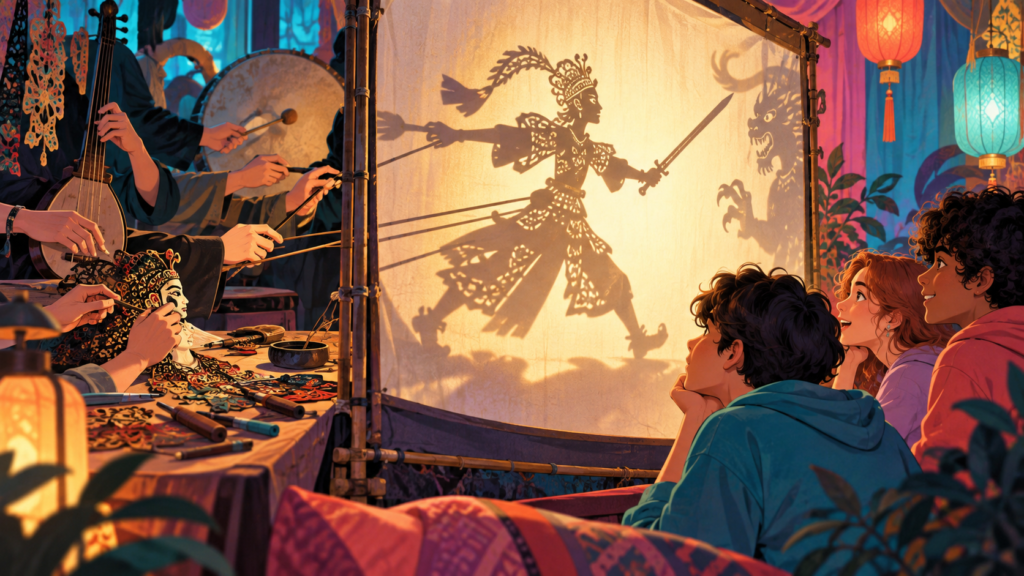
Imagine watching a figure cross a bright cloth screen. It seems to walk, turn and perhaps fight, though it is made from cut leather or paper. You may see only its shadow; the harder question is what everybody behind the screen is doing to make the moment work.
UNESCO describes Chinese shadow puppetry as theatre with coloured figures, rods, music and singing. A puppeteer may be moving several figures, changing their voices or playing an instrument. Some performers also carve the figures themselves. A single puppet can have a surprising number of moving joints.
More than a clever silhouette
The screen hides labour, which is part of its magic. You can focus on a character without seeing the person coordinating the movement. Yet it would be unfair to imagine the performers as invisible machine operators: their timing and interpretation are what give the figure its personality.
UNESCO notes that performances have taken place in different settings, including celebrations and ceremonies, and that skills pass through families, troupes and teacher–student relationships. There is no one show or one stage that represents every version of the art across China.
A voice, a hand and a cue
So how many people does it take? UNESCO describes larger troupes with seven to nine performers and smaller ones with two to five. Those are examples of how the work is organised, rather than a rule that every show needs the same number. A small group may ask each person to do several jobs.
The figures themselves can have between twelve and twenty-four movable joints, according to the same account. A joint lets one part move while another stays in place. It doesn’t decide when the movement should happen. That judgement belongs to the performer, who has to make the separate parts seem like one character.
Consider a simple scene you might invent: a character hears a noise, pauses and then turns. If the head turns before the sound, the moment tells a different story. If everything moves at once, the pause disappears. A tiny change in timing can alter what the audience thinks the character knows.
Adding a voice creates another layer. A performer might need to make the figure move while delivering its words, or coordinate with someone providing the sound. Music can shape the pace of a scene without being an object you can point to on the screen.
That is why counting the people only answers half the headline’s question. Knowing their number doesn’t tell you how they listen to each other, where they take their cues or how much practice a particular scene needs. The visible result can be smooth precisely because the coordination has been carefully worked out.
The craft also begins before the performance. Cutting a figure means considering how it will look and how it will move. A beautiful shape that cannot make the required gesture poses a practical problem for the person holding the rods. Design and performance meet in that small moving joint.
Could you make a character move?
If you wanted to try a paper version at home, drawing the character would be only the first challenge. Where would you place the joints? How would a hand wave without the whole body swinging? Could a second person add sound at exactly the right moment? The difficulty becomes obvious before you even begin a story.
That makes shadow theatre feel surprisingly close to animation. Both depend on tiny decisions made out of sight so that a viewer sees a living character. The materials and history differ, but the question behind the screen is familiar: how do you persuade an audience that a shape can think?
Compare two other ways of telling a story with a carefully made scene: Why does an opera need so little scenery? and Animation before computers.
Sources
- UNESCO: Chinese shadow puppetry