
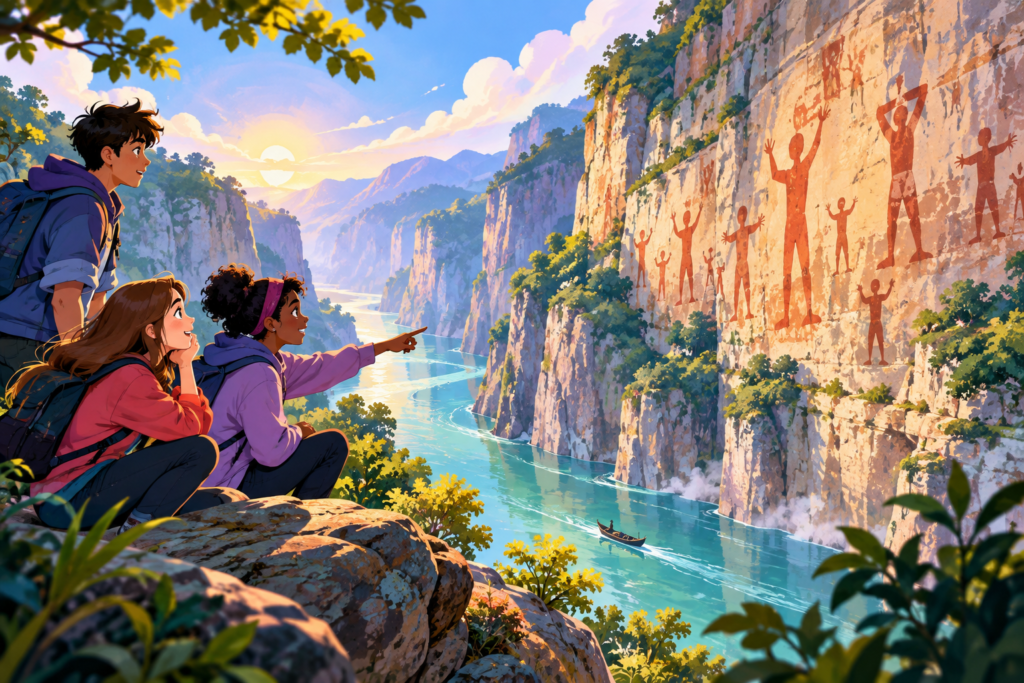
Red figures stand on steep karst cliffs along the Zuojiang River in Guangxi. The Huashan rock-art landscape is associated with the Luoyue people and belongs to a much wider river setting, not a single isolated “cave painting”.
UNESCO describes people, bronze drums and other forms among the painted images. Their exact meanings cannot be read as easily as a modern caption. Scholars interpret them through archaeology and landscape; uncertainty belongs in the story.
Pictures with a setting
The World Heritage property includes 38 rock-art sites, not just one famous panel. UNESCO dates them broadly from around the fifth century BCE to the second century CE. That span immediately asks us to think beyond a single moment of painting.
The figures belong to cliff faces beside a river landscape. Their placement is information in its own right: distance, height and the relationship with the water are part of what researchers examine when considering how the images were seen.
A close-up is useful for noticing a shape, but it can remove that relationship. If you see only a red figure against rock, you may not know whether it is one of many, how large it is or where it sits within the panel. The camera has made some details easier to see and others harder.
UNESCO connects the images with the Luoyue people and describes an interpretation involving bronze-drum culture. The important word is interpretation. Recognising an object or a repeated form gives researchers evidence to work with; it does not provide a complete transcript of the makers’ intentions.
Consider the difference between describing a figure and explaining it. A description might record raised arms, a position within a group or another visible feature. An explanation asks what that arrangement meant. The second step requires more supporting evidence than the first.
This does not make the art unknowable. It gives us a careful way to learn from it. Patterns across images, their archaeological setting and comparisons with other evidence can support an account while leaving some questions open.
A good museum or site caption should help a reader recognise those different levels. It can say what is present, explain the accepted interpretation and show where uncertainty remains. That is more useful than either a confident invented story or a refusal to discuss meaning at all.
The landscape also brings the art back into a place where people lived. These are not mysterious marks left by an undefined ancient population. They are evidence of particular communities, carried into the present on rock surfaces that still have a position beside the river.
The wall is not the whole page
If you looked only at a close-up, you might miss the river below and the difficult position of the paintings. Why put images where they could be seen from the water? The question may tell us more than a confident but unsupported answer.
The site rewards careful attention to what the evidence can and cannot tell us. Seeing a figure is not the same as knowing what its makers intended.
Explore next
- Can a pattern tell a family's story?
- What makes a mountain look red?
- Why put insects next to jewellery?
Sources
- UNESCO World Heritage Centre: Zuojiang Huashan Rock Art Cultural Landscape