
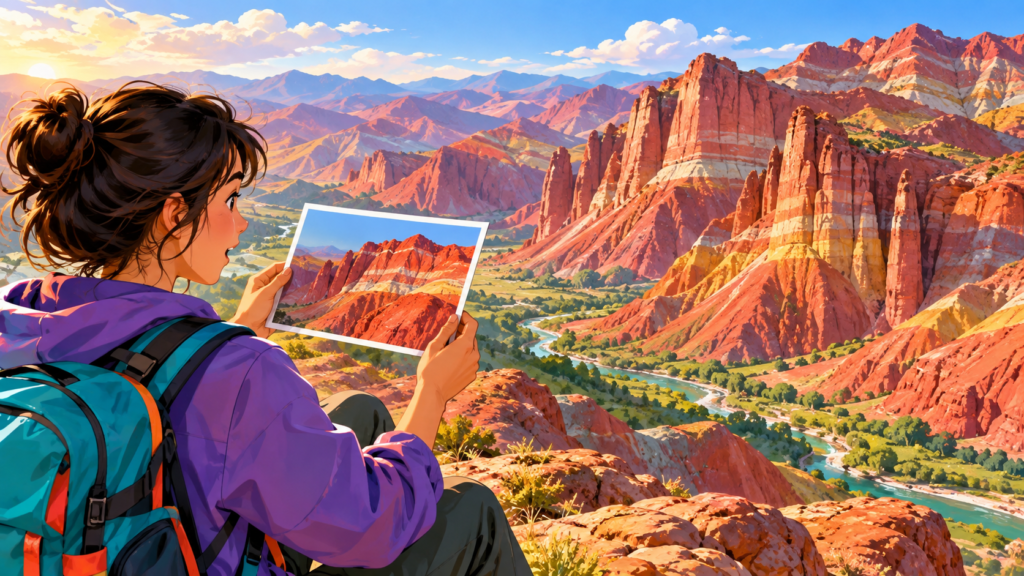
A red cliff draws your attention before you have worked out its shape. The colour makes it stand apart from the greenery around it, but the outline soon becomes just as interesting: a steep wall, a narrow passage or a separate block of rock can leave you wondering what used to connect them.
China Danxia, a UNESCO World Heritage property with six separate components, brings those questions together. Its landscapes developed in reddish sandstone and conglomerate, with rock movement, weathering and erosion contributing to the forms visible today. The colour is the starting point, not the whole explanation.
Looking past the red
Sandstone and conglomerate are not interchangeable names for one kind of surface. Sandstone contains sand-sized material, while conglomerate includes larger fragments bound into rock. The distinction helps explain why a landscape described with one name can still contain varied textures and forms.
A cliff also makes more sense when you look beyond its most dramatic face. What lies at its base? Is there a valley between the rock and the next ridge? Are parts of the slope covered in vegetation? These relationships tell you more than treating the cliff as an isolated object against the sky.
UNESCO’s account describes the interaction of forces working within the Earth and processes working on the surface. Uplift changes the position of rock; weathering and erosion help reshape what is exposed. A landscape can therefore record both the making of relief and the gradual removal of material.
Those are different kinds of change. It would be misleading to imagine a single event neatly carving every shape in one go. Equally, a still photograph cannot show the pace of the processes involved. It offers one view of a landscape with a much longer history.
The six components preserve different stages and combinations of these forms. That is useful for comparison: one striking photograph does not stand for every Danxia site. A steep cliff and a more divided landscape may belong to related processes without looking like copies of one another.
The spaces between the rocks
The property includes forest, rivers and waterfalls as well as exposed rock. Those features are part of the landscape, rather than convenient decorations around its main attraction. Water moves through the terrain, vegetation occupies different surfaces, and habitats extend into the less photographed spaces.
That changes the scale of the story. A distant view can show the relationship between ridges and valleys, while a closer view can reveal a texture or a channel that barely appears in the wider picture. Neither scale is enough by itself.
Photographs taken under different light or from different positions can also direct your attention towards different features. One might make the red surface dominate; another might show how much greenery surrounds it. Comparing views is useful because a landscape has more sides than its most familiar image.
If you want to understand why a mountain looks red, identifying the reddish rock is part of the answer. If you want to understand why it looks the way it does, you need the shape, the surrounding terrain and the processes too. Once you start looking at those together, the cliff becomes less like a coloured backdrop and more like a record you can learn to read.
Compare the different landscapes in these two stories about rock formations: Can rocks look like a city? and What did water take away at Guilin?.
Sources
- UNESCO World Heritage Centre: China Danxia