
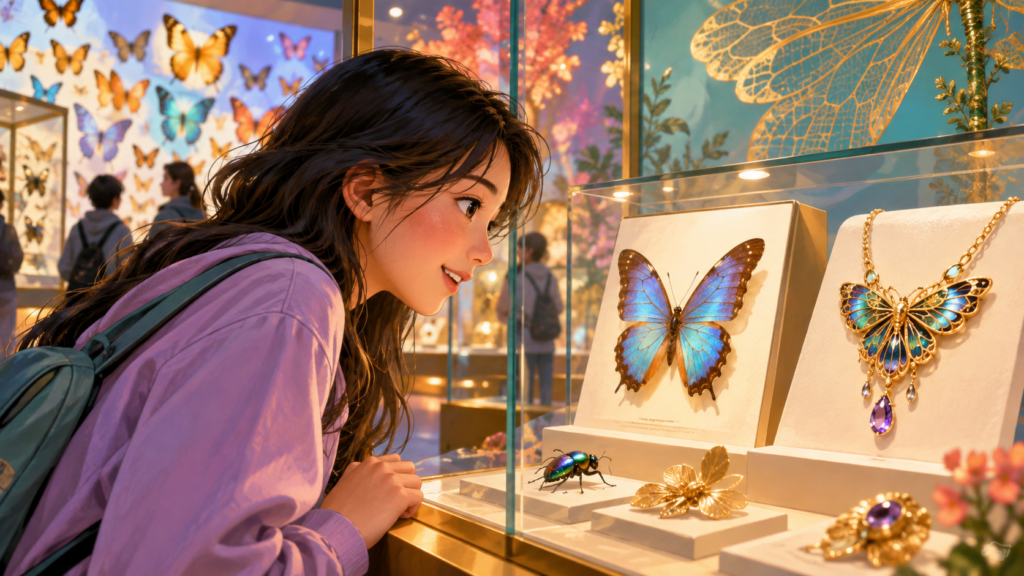
A butterfly wing and a piece of jewellery do not seem like natural neighbours in a museum case. The Peking Insect Museum in Beijing put them close enough to start a conversation. Its 2026 exhibition route included a butterfly wall and a section pairing insect specimens with antique jewellery.
The museum’s account describes a journey from a “natural prototype” to a “human response”. That sounds formal, but the question is simple: if a designer sees a pattern on an insect, what could they make from it?
Looking without taking
The shiny thing may catch your eye first. Look back at the insect and you might notice a curve, colour or repeating pattern echoed in the jewellery. The two objects are not identical. A human maker selected and changed parts of what they saw.
The museum also has live-insect areas and science education. That matters because insects are living animals, not only boxes of patterns for us to use. A show that makes you admire a wing should also make you wonder how the insect uses it.
Resemblance is the beginning of a question
Two things can look similar without one being a precise copy of the other. That is a useful distinction when a display puts natural specimens beside jewellery. The pairing invites comparison; understanding a particular ornament’s design would also require information about its maker and history.
The museum’s description gives a route from insects towards a human response. A visitor can follow that idea without assuming every similar curve proves the same story of inspiration. Looking carefully can produce a better question than instantly announcing that one object caused the other.
Try starting with a feature small enough to describe. It might be the arrangement of a pattern or the way a colour appears against its surroundings. Then look at how the ornament handles that feature. Has it kept a shape, changed a scale or repeated something that appears only once in the specimen?
Those are questions for looking, rather than claims about particular objects we haven’t inspected. They help explain how a designer can transform an idea instead of simply making a smaller insect from a different material.
The live-insect sections add another direction to the visit. A specimen shows a preserved form; a living animal also has behaviour. The city announcement describes education about ecological habits, giving the museum a purpose beyond finding beautiful patterns.
It is easy for a striking museum photograph to crop out that wider explanation. A butterfly wall may catch someone’s attention immediately, while learning about the animal requires spending longer with the display. Both kinds of interest can belong to the same visit.
You could leave with a design idea and a biological question. What does this shape do for the insect? What did the human maker choose to notice? The pairing becomes richer when neither object is reduced to decoration for the other.
Which object gets remembered?
Different visitors may leave with different favourites. Someone who loves fashion might begin with the jewellery; someone who loves biology might start at the specimen. If both leave curious about the other side of the case, the display has done something clever.
The museum opened in April 2026, according to Beijing’s city portal. Its exact exhibitions and entry arrangements could change, so this is an idea to explore rather than a current visiting guide. Next time you see a patterned bracelet, ask whether a living creature got there first.
Compare an insect habitat with another design inspired by a woven material: Why is a mountain also a library of insects? and How can a bamboo basket become a sweater?.
Sources
- Beijing Municipal Government: A Must-Visit New Museum in Beijing! Insect World Now Open