
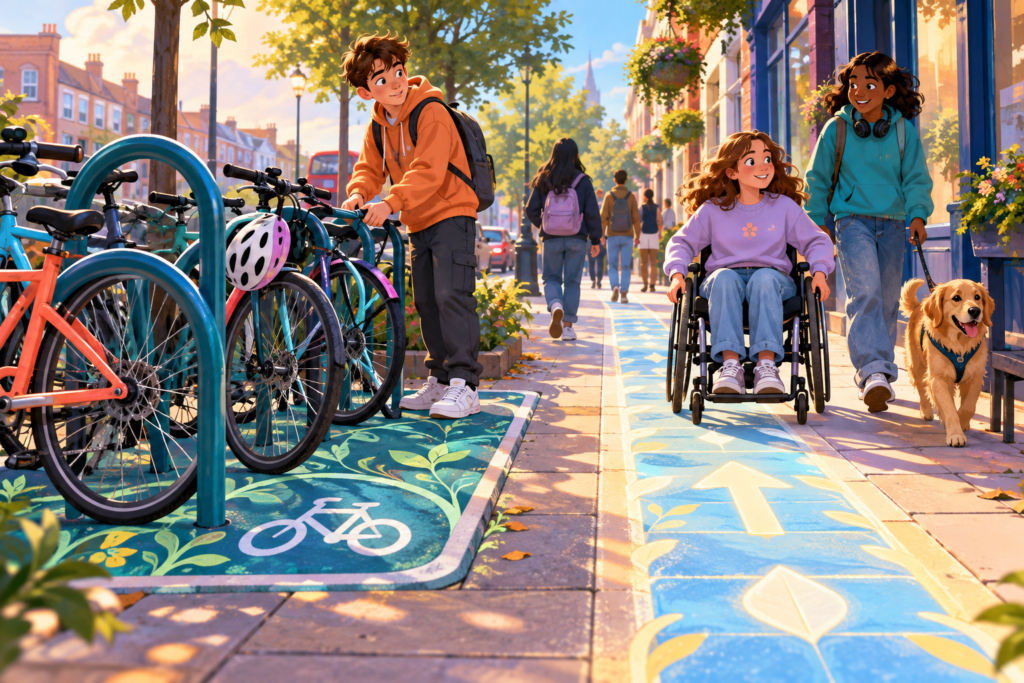
An app-based shared bicycle can seem wonderfully simple: unlock it, ride and leave it near where you finish. But a bike parked across a pavement is a problem for the next person, especially someone who needs a clear route.
Research on shared-bike parking in Beijing examines a problem that involves riders, companies and local government. Technology can help organise a service, but a usable pavement also depends on where the bicycles actually stand.
The app is not the whole street
A bike ride has an obvious beginning and end for its rider. Public space has no equivalent pause when the trip finishes. Other people continue using the pavement, entrances and crossings after the bicycle is left.
That changes what counts as a successful parking decision. Being close to your destination is useful, but it is only one requirement. The bicycle’s position also needs to leave appropriate space for the surrounding street’s other uses.
Consider an imaginary entrance with a narrow approach. A bike beside it may be convenient to collect while still making the route awkward for someone arriving with a pushchair or using mobility equipment. The problem is the relationship between the parked object and the available space.
A 2019 study focused on Beijing proposes cooperation among users, government and companies. Its account includes user behaviour, public management and technical support. The useful idea is that responsibility cannot be assigned to a single button in an app.
Companies can design the service and its parking instructions. Public authorities can organise street space and rules. Riders make decisions on the spot. Those roles connect, and a weakness in one can make the others’ work less effective.
Information also needs to be clear at the end of a journey. If the rider cannot understand where parking is appropriate, an instruction may fail even when it was intended to help. Good design has to work in the actual place where the decision is made.
The street’s capacity matters too. A space suitable for a few bikes may become crowded when many trips end there. Solving the problem involves anticipating use, not merely judging one neatly parked bicycle in an empty photograph.
This is why shared transport belongs to urban design as well as software. Its usefulness comes from giving people a convenient journey while fitting that journey into a place used by others. At the end of the ride, the question is quite ordinary: have you left the street in a condition that lets the next person’s journey continue?
Your ride, somebody else’s route
This is a design puzzle with two users. The rider wants convenience. Everyone else needs usable public space. Neither wish disappears because an app has a clever map.
Imagine drawing a parking area outside your school. Where would it be easiest to leave a bike, and where would it block someone? A good solution needs street design and good habits alongside technology.
A marked parking area also has to leave the route beyond it usable. Getting off the bicycle ends one journey, but the pavement continues to serve people passing through.
Explore next
- How would you explore a city by bike?
- Can a skatepark change a riverfront?
- Lunch delivery needs more than a drone
Sources
- Sustainability: shared-bicycle parking governance in Beijing