
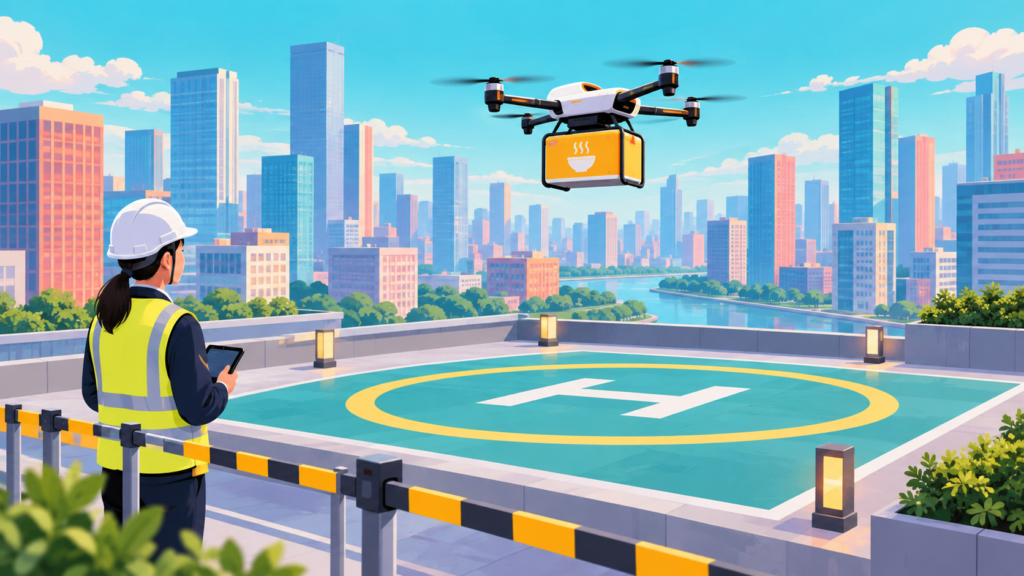
Order lunch and a drone appears in the sky: that is the version of delivery that fits in a ten-second video. The real system needs routes, a place to land, staff, weather checks and a way to keep the food moving before and after the flight.
In September 2026, a group of European university students visited Meituan’s Shanghai command centre and saw how the company presented its drone delivery and other systems. The city government’s account records their visit. It is a useful starting point, though a company demonstration cannot tell us whether every delivery is fast or practical.
The actual route along the West Bund
Meituan’s September 2026 launch report gives the service a much more specific setting: the West Bund riverside in Shanghai’s Xuhui district. It identifies West Bund Dream Center, Mosu Space and the McDonald’s on Longteng Avenue among locations connected with the launch. This is a network arranged around particular places, not permission for an aircraft to land wherever a hungry person happens to be sitting.
The report describes staff taking an order from the shop to a nearby smart transfer station. A mechanical arm handles loading and unloading there. The aircraft then travels on a planned route to a receiving station, where the customer collects the food. The flight sits between two organised handovers.
That arrangement answers a question the spectacular aerial footage can obscure: how does a meal get from a kitchen into an aircraft without somebody throwing it into the sky? People do the first part of the journey, and the station connects their work with the flying equipment.
The operator advertised deliveries taking as little as ten minutes. “As little as” describes a best-case claim, not the wait for every meal. More useful than the headline speed is the shape of the system: a shop, a transfer point, a flight and a collection point. The drone changes one section of the journey while depending on the others.
The sky is not an empty road
Before assuming the shortest line is a usable route, ask what operating conditions and permissions a particular service needs. Weather, landing arrangements and the surroundings are practical questions the visit report doesn’t fully answer.
The students also learned about autonomous delivery vehicles and a dispatch system. That wider picture matters: an order is information travelling through a network before a physical item moves at all. The drone is the most visible part, not the whole service.
Follow the lunch backwards
Start at the point where the customer receives the meal. Somebody has to know where the order will be collected and how the customer will recognise it. A flight ending at the wrong handover point hasn’t completed the useful part of delivery.
Now work backwards. Before the flight, food has to be prepared, packaged and matched to an order. Before that, the order has to reach the right business. Each stage passes an item or information to the next stage.
This is why the command-centre visit matters. The Shanghai account says the students learned about dispatch as well as aircraft and autonomous vehicles. Dispatch concerns coordinating tasks, not simply making one machine move.
The drone is a very visible link because it leaves the ground. The information linking a customer, an order and a destination is harder to film, though it can be just as important to the result. A beautiful aerial shot leaves that work largely out of view.
You could draw the service as a chain with two kinds of arrows. One shows where the food goes; the other shows where information goes. The arrows need to meet at the right moments. A ready meal without a correct order, or a correct order without a ready meal, leaves something unfinished.
Then add the possibility of an interruption. What if the next stage isn’t available? Who knows, and who explains the change to the customer? Those questions do not assume the service fails; they ask how a real system responds when a neat diagram meets ordinary life.
The visiting students discussed the technology with company employees. That sort of conversation can go beyond admiring the aircraft to asking how the links work together. Lunch is the end of the story for a hungry customer, but following it backwards reveals how much had to happen first.
Would you choose it?
Ask the question a customer actually cares about: does the food arrive safely, at a reasonable price and without making the neighbourhood unpleasant? Then ask workers how the system changes their jobs. Those are harder answers to get than a video of a neat landing.
The Shanghai visit shows technology students found worth inspecting. It does not prove that airborne lunch has become the normal way to eat in China. Sometimes the most honest technology story ends with a question still open.
Explore next
Sources
- Shanghai Municipal Government: European students explore Shanghai’s delivery drones, traditional crafts
- Meituan: Shanghai West Bund drone-delivery launch report, 11 September 2026